
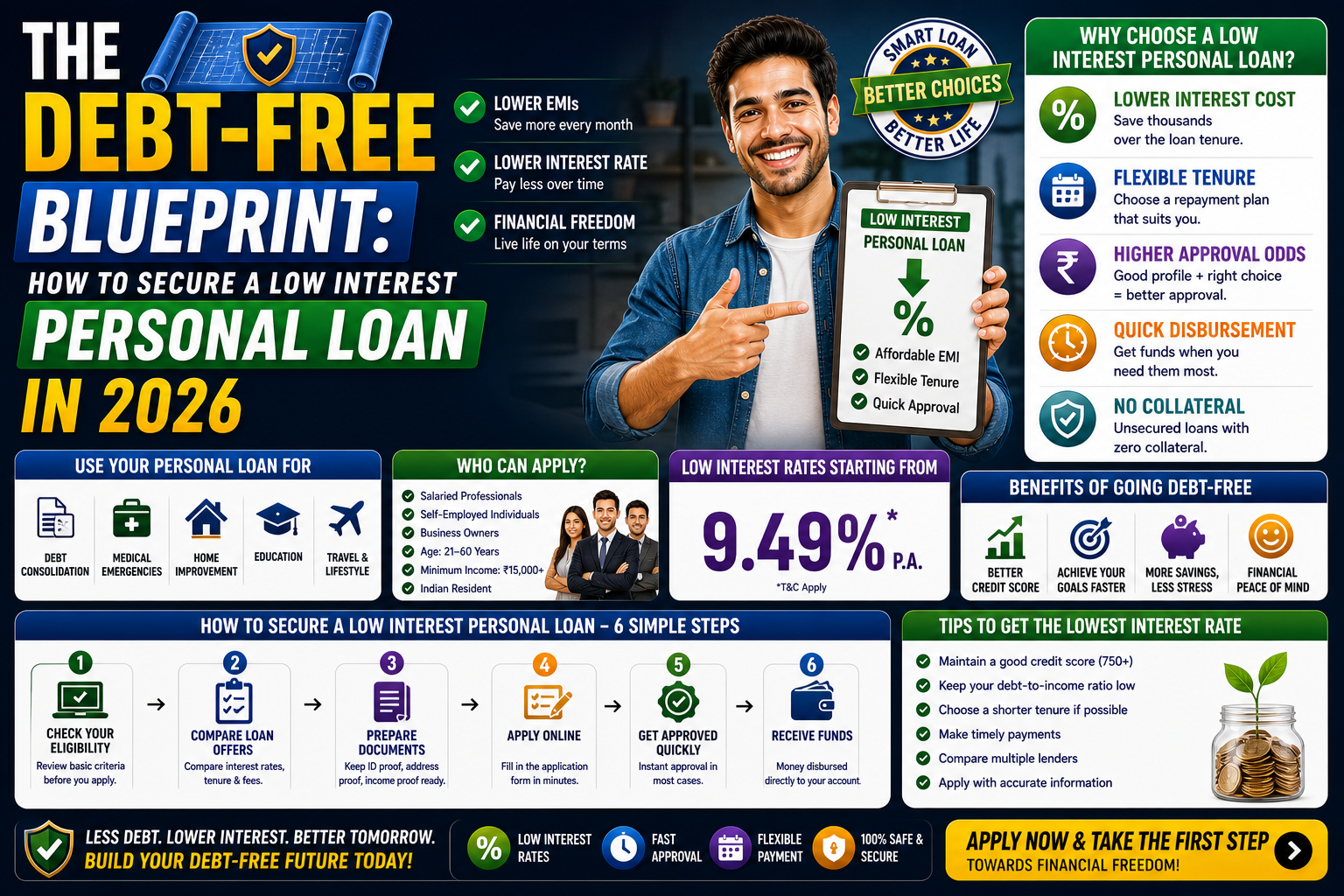
Tired of high APRs? Discover the secrets to securing a low interest personal loan, boosting your credit score, and choosing the right lender to save thousands.
Table of Contents
We’ve all been there—staring at a credit card statement and realizing that the interest charges are eating up more of our monthly budget than the actual purchases. It’s a frustrating cycle that feels impossible to break. Whether you’re looking to consolidate high-interest debt, renovate that kitchen you’ve hated for a decade, or cover an unexpected medical bill, the goal is always the same: find a way to borrow money without losing your shirt in the process. This is exactly why the hunt for a low interest personal loan has become a top priority for financially savvy people in 2026.
But here is the reality check: banks aren’t in the business of giving away money for free. They are risk managers. To land a low interest personal loan, you have to prove that you are the “safe bet” they are looking for. It’s not just about luck; it’s about understanding the mechanics of the lending world and making yourself the most attractive candidate possible. In an era where interest rates fluctuate like the weather, knowing how to navigate the digital lending landscape can be the difference between a manageable monthly payment and a financial nightmare.
Why Interest Rates Matter More Than You Think
It’s easy to get caught up in the “lump sum” of a loan, but the interest rate is what truly dictates your long-term wealth. A few percentage points might not seem like much on a $10,000 loan, but over five years, that difference can amount to thousands of dollars in “lost” money. When you secure a low interest personal loan, you aren’t just getting cash; you’re buying yourself financial breathing room.
Think of interest as the “price” of the money you’re renting. Just as you’d shop around for the best price on a new car or a laptop, you should be just as aggressive in shopping for the best price on your debt. A low interest personal loan acts as a tool that allows you to leverage capital today while protecting your future income from being swallowed by compounding interest.
The Foundation: Your Credit Score
If you want to walk into a bank (or click onto a lending site) and command a low interest personal loan, your credit score is your primary weapon. Lenders use this three-digit number to determine your “risk profile.” In 2026, the benchmarks have shifted slightly. While a 700 used to be the gold standard, many top-tier lenders now reserve their absolute lowest rates for those with a score of 740 or higher.
If your score is currently in the “fair” range, don’t panic. You can still find a low interest personal loan, but you might need to do some digital housekeeping first. Pay down your credit card balances to lower your “utilization ratio,” and double-check your report for any errors. Even a small mistake on an old bill can be the anchor dragging down your score and preventing you from qualifying for a low interest personal loan. According to investopedia, payment history remains the single most important factor in your score, so consistency is key.
Traditional Banks vs. Digital Disruptors
Where you look for your money is just as important as how much you ask for. In the quest for a low interest personal loan, you generally have two paths: the old-school high-street banks and the new-age fintech platforms.
- Traditional Banks: They love their existing customers. If you’ve had a checking account with the same bank for ten years, they might offer you a “relationship discount” on a low interest personal loan.
- Fintech & Peer-to-Peer Lenders: These platforms use sophisticated algorithms to look at more than just your credit score. They might consider your education or your career path to justify a low interest personal loan that a traditional bank might reject.
I’m a firm believer that you should play both sides. Get a quote from your local bank, then take that quote to a digital lender and see if they can beat it. This competitive tension is exactly how you land a low interest personal loan that actually fits your budget.
The Debt-to-Income Ratio: The Silent Killer
You could have a perfect credit score, but if half of your monthly income is already going toward other debts, a lender is going to hesitate to give you a low interest personal loan. This is known as your Debt-to-Income (DTI) ratio. Lenders want to see that you have enough “extra” cash at the end of the month to comfortably handle a new payment.
To maximize your chances for a low interest personal loan, try to keep your DTI below 36%. If you’re currently over that limit, it might be worth paying down some smaller debts before you apply for a major low interest personal loan. It shows the lender that you are in control of your cash flow, rather than just surviving from paycheck to paycheck.
Fixed vs. Variable Rates: Choosing Your Side
When you’re browsing for a low interest personal loan, you’ll likely see two options for your interest structure.
- Fixed Rates: Your rate stays the same for the entire life of the loan. This is the bedrock of a stable low interest personal loan because your payment never changes.
- Variable Rates: These often start lower but can rise if the economy changes.
In my mild opinion, unless you plan to pay the loan off in less than a year, the fixed-rate low interest personal loan is almost always the winner. The peace of mind that comes with knowing your payment won’t spike is worth the slightly higher starting rate. You can find more technical data on how these rates are influenced by the Federal Reserve and global economic trends.
The Hidden Costs: Fees That Kill the Deal
Here is where people get tripped up. A lender might offer you what looks like a low interest personal loan, but then they bury “origination fees” or “processing fees” in the fine print. An origination fee is a percentage of the loan (usually 1% to 8%) that the bank takes right off the top.
If you get a $10,000 low interest personal loan with a 5% fee, you only actually receive $9,500 in your bank account, but you’re still paying interest on the full $10,000. When comparing offers, always look at the Annual Percentage Rate (APR). The APR is the “true” cost of the loan because it includes both the interest and the fees. A low interest personal loan with a 7% interest rate and no fees is better than a 5% interest rate with a massive fee.
Using a Co-signer: The “Secret” Lever
If your credit isn’t quite where it needs to be to snag a low interest personal loan, you might consider a co-signer. This is someone with a stellar credit history who agrees to be responsible for the loan if you can’t pay.
Having a co-signer significantly lowers the risk for the lender, which is often enough to unlock a low interest personal loan that you couldn’t get on your own. Just be careful—if you miss a payment, it’s their credit score on the line, too. It’s a move that requires a lot of trust and clear communication.
The Speed of Digital Approvals in 2026
We’ve moved past the era of waiting two weeks for a loan decision. In 2026, most low interest personal loan applications can be completed on your phone in under ten minutes. Many lenders use “soft credit pulls” for pre-qualification, which means you can see your potential rate without hurting your credit score.
I always suggest checking at least three different platforms. Since these initial checks don’t impact your credit, there is no reason not to shop around for a low interest personal loan. It’s the easiest “work” you’ll ever do for a thousand-dollar return. Once you find the right fit, the funds for your low interest personal loan can often be in your account within 24 to 48 hours.
Strategic Repayment: Protecting Your Progress
Once you’ve secured your low interest personal loan, the real work begins. The goal is to pay it off as quickly as possible. Check if your loan has “prepayment penalties.” The best low interest personal loan providers in 2026 don’t charge you extra for paying the loan off early.
By making even one extra payment a year, you can drastically reduce the total interest you pay. It’s about taking the win of a low interest personal loan and compounding it with smart financial habits. For more on how these loan structures are categorized, Wikipedia’s entry on Personal Loans offers a good high-level overview.
FAQ Section
1. What is considered a “low” interest rate for a personal loan in 2026? While it varies based on the economy, a low interest personal loan typically sits in the 6% to 10% range for borrowers with excellent credit. If you’re seeing rates north of 15%, you might want to work on your credit score before applying.
2. Can I get a low interest personal loan with fair credit? It’s more challenging, but possible. You might need to look at credit unions or online lenders that specialize in “rebuilding” credit. A low interest personal loan for fair credit might be in the 12% to 15% range.
3. Will applying for a personal loan hurt my credit score? A formal application involves a “hard pull,” which might drop your score by 5 to 10 points temporarily. However, most lenders let you check for a low interest personal loan with a “soft pull” first, which has zero impact on your score.
4. Is it better to use a credit card or a personal loan? If you can’t pay off the balance in 30 days, a low interest personal loan is almost always better. Credit card interest rates are often double or triple the rates of a standard personal loan.
5. What can I use a personal loan for? Almost anything! Most people use a low interest personal loan for debt consolidation, home improvements, or major life events like weddings or medical procedures.
6. How long does it take to get the money? With modern digital lenders, once your low interest personal loan is approved, the funds can be in your bank account in as little as one business day.
Conclusion
At the end of the day, borrowing money is a tool. When used correctly, a low interest personal loan can be the bridge that gets you from a high-stress financial situation to a place of stability and growth. It’s about being an active participant in your own financial life—doing the research, checking the fine print, and refusing to settle for the first high-interest offer that comes your way.
