
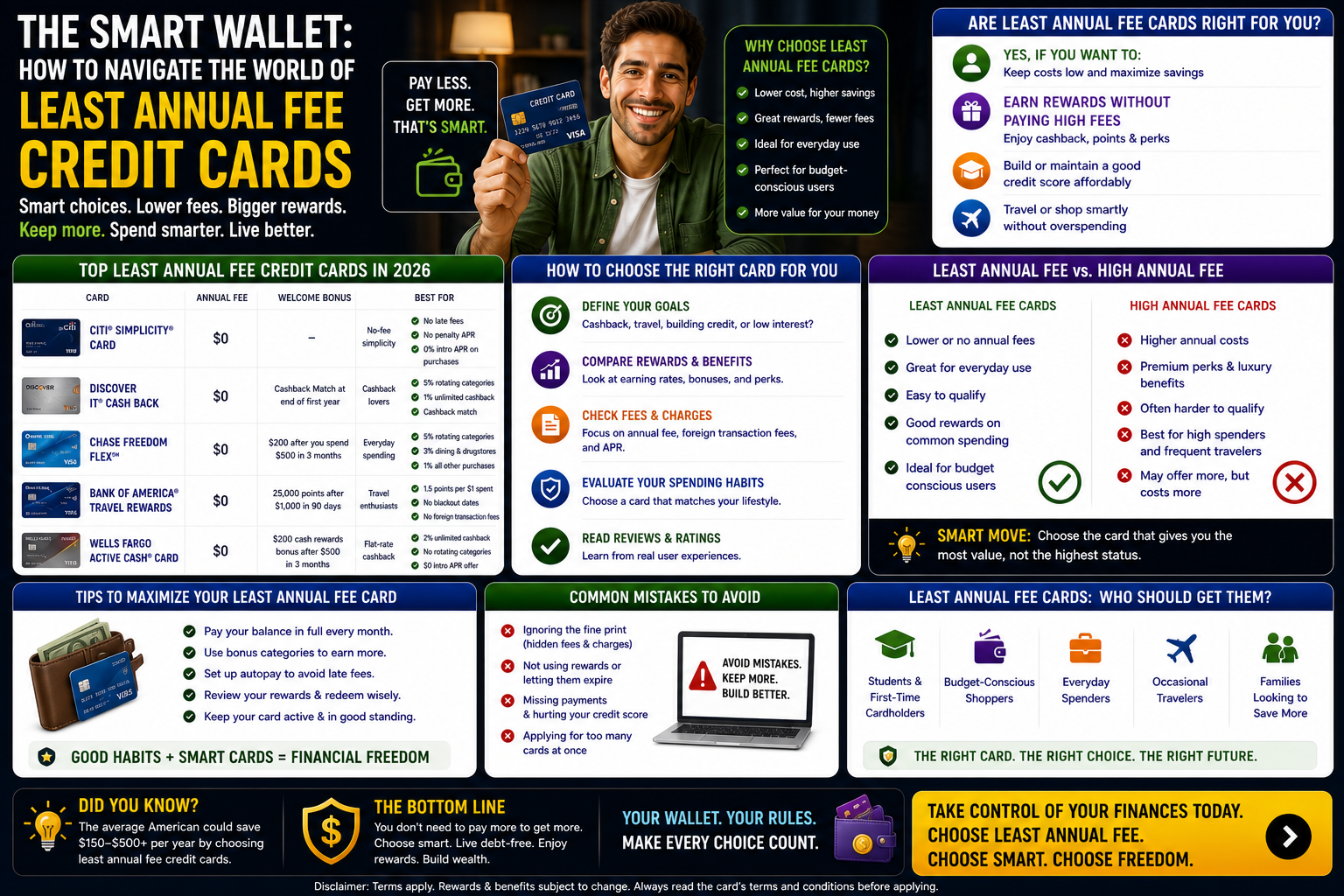
Stop overpaying for perks you don’t use! Learn how to find the least annual fee credit cards in 2026, maximize cash back, and keep your hard-earned money.
Table of Contents
We’ve all been there—scrolling through a bank’s website, lured by the promise of airport lounges, concierge services, and flashy metal cards, only to see an annual fee that rivals a monthly car payment. It feels a bit like being charged a subscription fee just to spend your own money. For most of us, those “ultra-premium” cards are more of a vanity project than a financial tool. The reality is that for the average person, the best value often lies with the least annual fee credit cards. These are the workhorses of the financial world—cards that give you the rewards you actually want without a $500 “membership” bill hitting your statement every December.
Choosing the least annual fee credit cards isn’t about being cheap; it’s about being efficient. It’s about realizing that you don’t need a heavy card to have a heavy bank account. In 2026, the competition among lenders has become so fierce that “no-fee” or “low-fee” cards are offering perks that were previously reserved for the elite. Whether you’re a student building a credit history or a seasoned professional looking to trim unnecessary expenses, understanding how to leverage the least annual fee credit cards is one of the easiest ways to give yourself an instant raise.
The Psychological Win of the No-Fee Card
There’s a certain peace of mind that comes with knowing your credit line doesn’t have an expiration date on its value. When you carry the least annual fee credit cards, you don’t have to do “mental math” to justify the cost. You never have to ask yourself, “Did I earn enough points this year to cover that $95 fee?” If you use the card once a month or a hundred times, you’re in the black from the very first transaction.
This is especially vital for your credit score longevity. Because the “age of accounts” is a massive factor in your credit health, you want cards you can keep forever. Closing a card because you don’t want to pay the fee anymore can actually hurt your score. By sticking with the least annual fee credit cards, you can keep those accounts open for decades at zero cost, creating a rock-solid foundation for your financial future.
Breaking Down the Rewards: Cash Back vs. Points
In the realm of the least annual fee credit cards, you generally have two paths: simplicity or optimization.
- Flat-Rate Cash Back: These are the “set it and forget it” champions. You usually get 1.5% to 2% back on everything. No categories, no activation buttons, just pure savings.
- Tiered Category Cards: These least annual fee credit cards offer higher rewards (like 3% or 5%) on specific things like groceries, gas, or dining, while giving 1% on everything else.
I personally believe that for most people, a flat-rate card is the least annual fee credit cards winner. It removes the mental load of trying to remember which card to use at the pharmacy versus the hardware store. However, if you spend a huge chunk of your budget on a single category, a tiered card can be a powerful wealth-building tool.
The Secret Perks of “Basic” Plastic
Don’t let the lack of a fee fool you; these cards are far from “basic.” Many of the least annual fee credit cards in 2026 come backed by Mastercard or Visa networks that include some surprisingly robust protections. I’m talking about things like “Purchase Protection,” where the bank might reimburse you if your new phone is stolen or damaged within 90 days of purchase.
Another hidden gem found in many of the least annual fee credit cards is “Extended Warranty Protection.” If you buy a laptop that has a one-year manufacturer warranty, the card can often add a second year for free. For more details on how these standardized card benefits work across the industry, Wikipedia’s entry on Credit Card Benefits offers a great deep dive into the legalities of these protections.
Navigating the “Introductory APR” Strategy
One of the most tactical ways to use the least annual fee credit cards is for large, planned expenses. Many of these cards offer a 0% Introductory APR for 12 to 18 months. This is essentially a free loan from the bank, provided you are disciplined enough to pay it off before the period ends.
Whether you’re furnishing a new apartment or consolidating some high-interest debt, moving that balance to one of the least annual fee credit cards can save you hundreds in interest charges. It gives you the breathing room to pay down the principal without the “interest snowball” getting in your way. Just make sure to set a calendar alert for when that intro period ends—you don’t want to be caught off guard by the standard rate.
Foreign Transaction Fees: The Hidden Tax
If you travel internationally even once a year, you need to be careful. Some of the least annual fee credit cards charge a 3% “Foreign Transaction Fee” every time you swipe your card outside your home country. On a $2,000 vacation, that’s $60 down the drain for absolutely no reason.
The good news? There are plenty of the least annual fee credit cards in 2026 that have eliminated this fee entirely. If you’re a digital nomad or just a frequent vacationer, finding a card that combines no annual fee with no foreign transaction fees is the ultimate travel hack. It allows you to spend your money on experiences rather than bank administrative costs. According to the Consumer Financial Protection Bureau, transparency in these fees is a major focus of modern financial regulation.
Why Credit Unions Are the Unsung Heroes
While the big national banks spend billions on commercials, local credit unions are often where you’ll find the absolute least annual fee credit cards. Because they are member-owned and not-for-profit, they aren’t trying to extract every possible penny from your wallet.
Credit unions often have lower interest rates and more “human” customer service. If you’re tired of being treated like a number by a giant institution, a credit union’s version of the least annual fee credit cards might be a perfect fit. They often have lower late fees and more forgiving terms if you hit a rough patch, making them a safer choice for many families.
The Role of Welcome Bonuses in No-Fee Cards
You might think that sign-up bonuses are only for the expensive cards, but that’s a myth. Many of the least annual fee credit cards offer “Welcome Bonuses” of $150 to $250 after you spend a relatively small amount (usually $500 to $1,000) in the first three months.
Think about the math there: if you get $200 back for spending $1,000 on things you were going to buy anyway (like groceries and gas), you’ve essentially just received a 20% discount on your life. When you combine a sign-up bonus with the long-term benefits of the least annual fee credit cards, you are coming out way ahead of the people paying $695 for “status.”
Security Features in the Digital Age
In 2026, security is no longer a luxury. The least annual fee credit cards come equipped with the same high-end encryption and “Zero Liability” policies as their premium counterparts. If your card number is stolen and someone goes on a shopping spree, you aren’t on the hook for a single cent.
Most of these cards also offer “Virtual Card Numbers” through their mobile apps. This allows you to shop online using a temporary number so your “real” card details are never exposed to potentially sketchy websites. Even with the least annual fee credit cards, you are getting a fortress of digital protection that a standard debit card simply cannot match.
Balancing Your “Card Portfolio”
I’m a firm believer in the “Power Pair” strategy. You don’t need ten cards; you just need two of the least annual fee credit cards that complement each other.
- Card 1: A flat-rate 2% cash back card for your general spending.
- Card 2: A card that gives 3% or 5% back in your highest spending category (like groceries or gas).
By using this simple two-card system, you maximize your rewards on every single dollar without ever paying an annual fee. It’s an elegant, efficient way to manage your money that requires about five minutes of effort a month. The least annual fee credit cards are the bricks you use to build a stable financial house.
FAQ Section
1. Are the least annual fee credit cards worse for my credit score? Actually, they are often better! Because they are free to keep open, they help you maintain a long “average age of accounts,” which is a major positive for your credit score. Many people close expensive cards when they get tired of the fee, which can actually hurt their score.
2. Can I get travel rewards with the least annual fee credit cards? Yes! While you might not get airport lounge access, there are several the least annual fee credit cards that earn travel points or miles that can be redeemed for flights and hotels.
3. Is “No Annual Fee” the same as “Least Annual Fee”? Mostly, yes. Most people looking for the least annual fee credit cards are aiming for $0. However, some specialized cards (like those for people rebuilding credit) might have a small fee of $35 or $39.
4. Do I need a high income to qualify for these cards? Not necessarily. The least annual fee credit cards have a wide range of requirements. Some are designed for students or people just starting out, while others are for those with excellent credit scores.
5. What happens if I miss a payment on a no-fee card? The “no fee” part only applies to the annual membership. You will still be charged a “Late Fee” and interest if you don’t pay your bill on time. It is always best to set up “Autopay” for at least the minimum amount to avoid this.
6. Can I upgrade my no-fee card later? Yes! Most banks will allow you to “product change” from one of the least annual fee credit cards to a premium card if your lifestyle changes and you start traveling enough to justify a higher fee.
Conclusion
At the end of the day, your credit card should be a tool that serves you, not a burden that you have to serve. The world of the least annual fee credit cards is wider and more rewarding than ever before. By being intentional about which cards you carry, you can enjoy high-end security, significant cash back, and valuable consumer protections without ever seeing a “membership fee” on your statement.
