Navigating the world of venture capital and grants? Discover the most effective startup funding options for 2026 to grow your business without losing your mind.
Table of Contents
Every founder has that specific “lightbulb” moment. It’s that exhilarating second when an idea clicks, and you realize you’ve found a solution to a problem that’s been nagging at people for years. You start sketching on napkins, building prototypes in your spare room, and boring your friends with talk of “disruption.” But very quickly, the cold, hard reality of economics sets in. You realize that vision alone won’t pay for servers, inventory, or the talented developers you need to hire. This is the crossroads where almost every entrepreneur begins the frantic search for the right startup funding options.
In 2026, the landscape of capital has shifted. We’ve moved away from the “growth at any cost” era and into a world where sustainability and profitability are the new cool. This change actually works in your favor; it means the variety of startup funding options is more robust and tailored than ever. Whether you’re looking for a small injection of cash to get off the ground or a massive Series A to scale globally, understanding the mechanics of how money moves is the most valuable skill you can possess. It’s time to stop guessing and start strategizing.
Bootstrapping: The Power of Self-Reliance
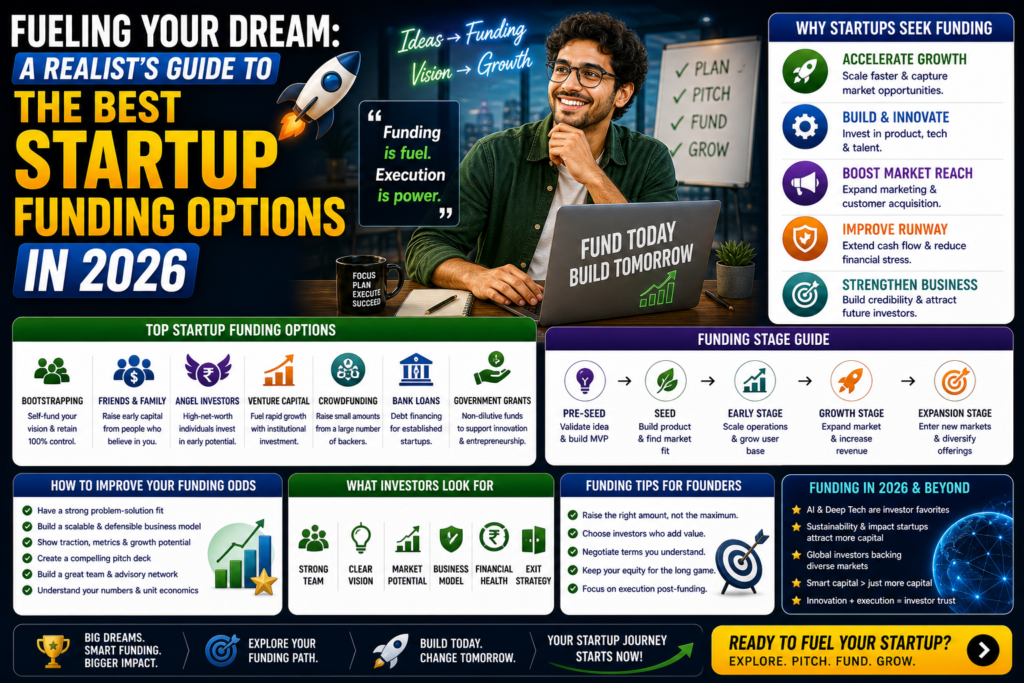
Before you go hunting for external capital, you have to look at your own pockets. Bootstrapping—funding your business through personal savings and early revenue—is often overlooked in the flashy world of tech news. However, it remains one of the most powerful startup funding options because it gives you 100% control. You aren’t answering to a board of directors or worrying about “exit timelines.”
I’m a firm believer that the more you can bootstrap in the early days, the better. It forces you to be lean, to listen to your customers, and to find a product-market fit without the “padding” of venture cash. When you eventually do decide to look for other startup funding options, having a bootstrapped business with actual paying customers makes you an absolute magnet for investors. You aren’t selling a dream anymore; you’re selling a proven engine.
The Role of Angel Investors
Once you’ve outgrown your savings, your next stop is usually “Angels.” These are typically high-net-worth individuals who invest their own money into early-stage companies. For many founders, this is the most relatable of the startup funding options because it’s often about the relationship. You aren’t just getting a check; you’re getting a mentor who has likely been exactly where you are now.
In 2026, angel groups have become much more organized and niche-focused. You can find angels who only invest in sustainable fashion, or those who only care about B2B SaaS. When exploring these startup funding options, don’t just look for the money; look for the “smart money.” An investor who can open doors at a major retailer or introduce you to a key manufacturing partner is worth ten times the amount on their check.
Venture Capital: The High-Octane Route
We can’t talk about startup funding options without mentioning the heavy hitters: Venture Capital (VC). If your goal is to build a “Unicorn” and you need millions of dollars to dominate a market overnight, VC is your path. It is high-octane fuel for high-growth engines. However, it comes with a trade-off. You are selling a piece of your company, and with that comes high expectations for an eventual “exit” via acquisition or IPO.
Navigating VC as one of your startup funding options requires a thick skin. You will hear “no” a hundred times before you hear a “yes.” In 2026, VCs are looking for “unit economics” that make sense. They want to see that for every dollar they give you, you can predictably turn it into three. For a deeper look at how the VC ecosystem functions, Wikipedia’s entry on Venture Capital offers an excellent historical and structural overview.
Crowdfunding: Validating with the Crowd
If your business is consumer-facing, crowdfunding has become one of the most effective startup funding options to validate your idea while raising cash. Platforms like Kickstarter and Indiegogo allow you to pre-sell your product to the very people who will use it. It’s a win-win: you get the capital to manufacture your first run, and you build a community of brand ambassadors before you even launch.
But there’s a newer player in the game: Equity Crowdfunding. This allows everyday people to own a tiny slice of your company. As far as startup funding options go, this is the most democratic. It turns your customers into shareholders. When your users have skin in the game, they aren’t just customers; they’re a sales force. According to the U.S. Securities and Exchange Commission, the regulations around these offerings have become much more founder-friendly recently.
Small Business Loans and Credit Lines
Sometimes, the best of the startup funding options isn’t equity, but debt. If your business has consistent revenue and tangible assets, a traditional small business loan might be the way to go. The beauty of debt is that it doesn’t dilute your ownership. You pay a set interest rate, and once the loan is paid off, the bank is out of your hair.
In 2026, fintech lenders have made this process incredibly fast. You can often apply for a line of credit or a term loan online and get a decision in forty-eight hours. When comparing these startup funding options, pay close attention to the APR and “origination fees.” Debt is a tool, but if mismanaged, it can become an anchor. Use it for things that generate more cash, like equipment or inventory.
Government Grants and Competitions
If you are working on something truly innovative—think deep-tech, green energy, or biotech—don’t overlook government grants. These are the holy grail of startup funding options because they are “non-dilutive.” It’s basically “free” money that you never have to pay back, and you don’t give up any equity.
The downside? The paperwork is legendary. You’ll need to be meticulous with your reporting and follow strict guidelines. Similarly, startup competitions and “pitch fests” are great startup funding options for early-stage validation. Winning a $50,000 prize might not fund your whole year, but the press and prestige that come with it can help you unlock much larger investments down the road.
Accelerators and Incubators
Programs like Y Combinator or Techstars offer a “package deal.” You get a small amount of capital, intensive mentorship, and a network that would take years to build on your own. For a first-time founder, these are fantastic startup funding options because they provide a “crash course” in entrepreneurship.
You’ll usually give up around 5% to 7% of your equity in exchange for the program. My mild opinion? It’s almost always worth it. The “stamp of approval” from a top-tier accelerator makes all your future startup funding options much easier to access. It’s like having a degree from Harvard for the startup world; it opens doors that are otherwise locked tight.
Revenue-Based Financing
For businesses that already have steady sales, revenue-based financing is a modern alternative to traditional VC. Instead of giving up equity, you agree to pay the investor a small percentage of your monthly revenue until a pre-agreed “cap” is reached.
This is one of the most flexible startup funding options available in 2026. If you have a slow month, you pay less. If you have a blockbuster month, you pay more and get the debt off your books faster. It aligns the investor’s interests with your growth without the pressure of a “forced exit.” It’s an elegant solution for founders who want to keep their company for the long haul.
FAQ Section
1. When is the right time to seek startup funding options? Ideally, you should look for funding when you’ve reached a point where more capital is the only thing standing between you and significant growth. If you don’t have a clear plan for how that money will be used, it’s probably too early to explore external startup funding options.
2. How much equity should I give away in the beginning? In an initial seed round, most founders give away between 10% and 20%. Be careful not to dilute yourself too much early on, or you’ll find it difficult to attract VCs for later startup funding options in Series A or B.
3. Are there startup funding options for people with bad credit? Yes. Bootstrapping, crowdfunding, and grants don’t usually require a credit check. Equity-based startup funding options like Angel investment or VC are focused on the business’s potential, not your personal credit score.
4. What is a “pitch deck” and do I need one? A pitch deck is a 10-15 slide presentation that outlines your business, the problem you’re solving, your team, and your financials. You will need one for almost all startup funding options involving external investors.
5. Is debt better than equity for a startup? There is no “better,” only what’s right for your stage. Equity is great for high-risk, early-stage growth where you can’t afford monthly payments. Debt is better for established startup funding options where you have predictable cash flow and want to maintain ownership.
6. Do I need a lawyer for the funding process? Absolutely. Whenever you are signing away equity or taking on debt, you need professional legal advice. It might feel expensive now, but it will save you a fortune (and your company) in the future.
Conclusion
At the end of the day, your startup is your baby, and choosing how to fund it is one of the most significant decisions you will ever make. Don’t be swayed by the “hype” of a massive VC round if it doesn’t align with your personal goals. There is no one-size-fits-all approach to startup funding options.
