
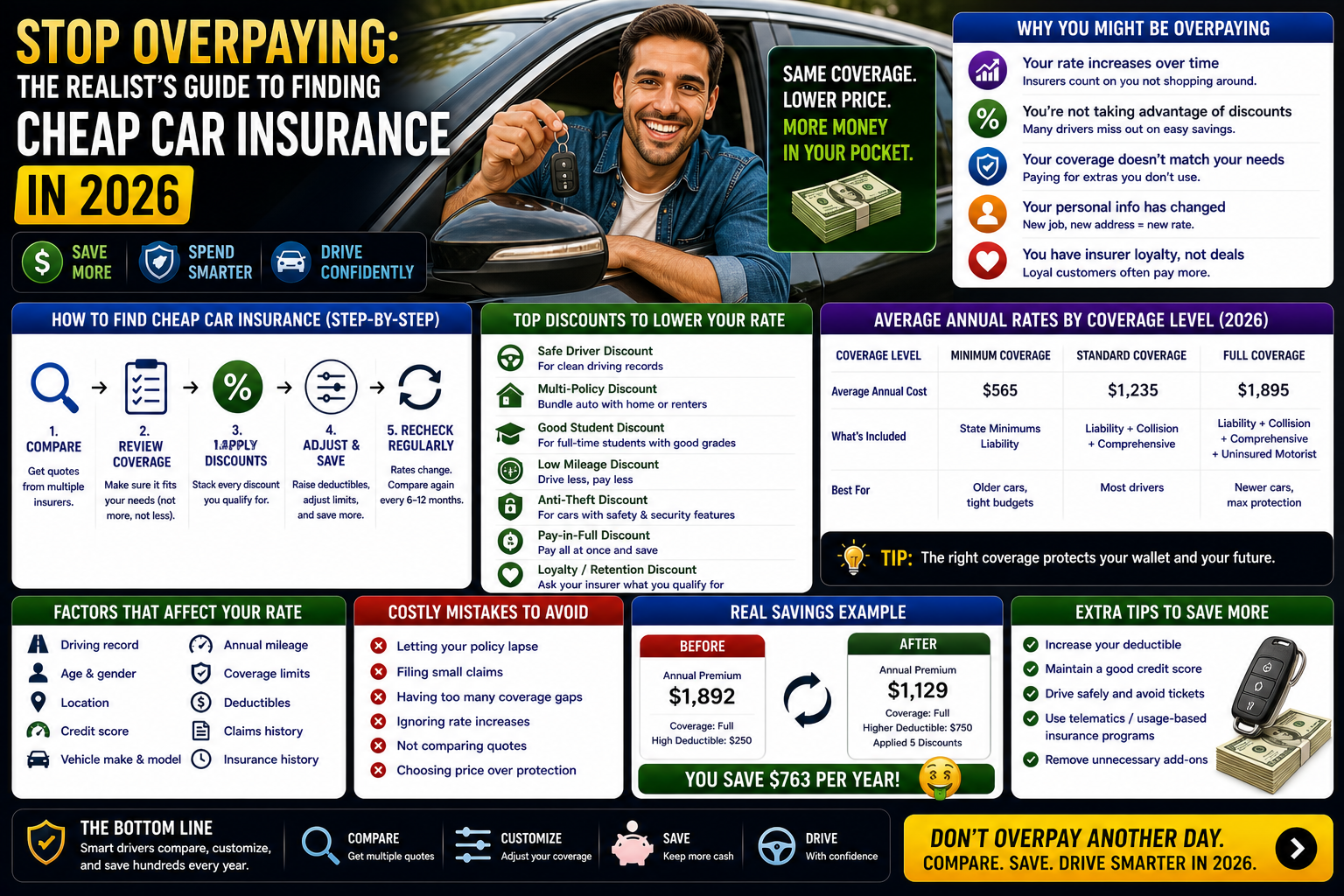
Tired of skyrocketing premiums? Learn the insider secrets to securing cheap car insurance in 2026 without sacrificing the coverage you actually need.
Table of Contents
Let’s be honest: opening your auto insurance renewal notice is rarely a “feel-good” moment. For most of us, it’s a quick scan for the total price followed by a deep sigh of frustration. As we navigate through 2026, the cost of keeping a vehicle on the road seems to be climbing faster than a mountain goat on espresso. Between the rising costs of specialized vehicle parts and the frequency of climate-related claims, finding cheap car insurance can feel like trying to find a needle in a digital haystack. But here’s the thing—it’s not impossible. You just have to stop playing by the insurance companies’ old rules.
I’ve spent a lot of time digging into the mechanics of how these companies price their risk. Most people treat their insurance policy like a “set it and forget it” utility, but that loyalty usually costs you a “laziness tax.” If you haven’t shopped around in the last twelve months, you are almost certainly paying more than you should. Finding cheap car insurance isn’t about getting lucky; it’s about understanding the specific levers you can pull to force those numbers down. It’s time to stop venting about the prices and start doing something about them.
Why Your Current Rate is So High
Before you can fix the problem, you have to understand the “why” behind your bill. Insurance companies use massive amounts of data to predict how likely you are to cost them money. In 2026, even things like your credit score and your ZIP code play a massive role in whether or not you qualify for cheap car insurance. If you live in an area with high rates of theft or frequent hailstorms, your insurer sees a red flag.
Furthermore, the car you drive is a huge factor. A modern electric vehicle with sensors in every bumper is significantly more expensive to repair than a ten-year-old sedan. If you’re hunting for cheap car insurance, you might find that your high-tech safety features are actually driving your premiums up because of the specialized labor required to fix them after a fender bender. It’s a bit of a paradox, but it’s the reality of the current market.
Master the Deductible Strategy
The easiest and most immediate way to secure cheap car insurance is to take on a little more of the risk yourself. This means raising your deductible. If you have a $250 deductible, you are basically asking the insurance company to handle every minor scrape. That convenience costs you a fortune in monthly premiums.
By raising that deductible to $1,000, you can often see a double-digit percentage drop in your bill. Of course, you should only do this if you actually have that $1,000 sitting in an emergency fund. It’s a strategic move to get cheap car insurance that relies on you being your own “mini-insurer” for small mishaps. For many, this single change is enough to balance the monthly budget.
The 2026 Shift: Usage-Based Insurance (UBI)
If you consider yourself a safe driver, why are you paying the same rate as the person who treats every green light like a drag race? In 2026, telematics and “pay-how-you-drive” programs have become the ultimate shortcut to cheap car insurance. By allowing an app on your phone or a device in your car to track your braking, speed, and mileage, you can get a personalized rate.
- Low-Mileage Discounts: If you work from home and only drive 5,000 miles a year, you shouldn’t be paying the same as a long-distance commuter.
- Safe Driving Perks: No hard braking or late-night driving? That data is your best leverage for cheap car insurance.
I’ve seen drivers save up to 30% just by proving they aren’t a high-risk liability. It’s the most transparent way to get rewarded for your actual behavior rather than a demographic stereotype.
Decoding the Different Coverage Types
Sometimes we have expensive insurance because we are paying for things we don’t actually need. To find truly cheap car insurance, you have to audit your coverage levels. If your car is worth $3,000, does it really make sense to pay for full collision and comprehensive coverage? Probably not.
- Liability Only: The bare minimum required by law. If your car is old, this is the fast track to cheap car insurance.
- Uninsured Motorist Coverage: In some states, this is vital. It’s worth the small extra cost to protect yourself from others’ mistakes.
- Comprehensive: Covers “Acts of God” like fire or theft. Useful, but can be trimmed on older vehicles.
As you compare options, look at the National Association of Insurance Commissioners (NAIC) data on average premiums in your state. It gives you a baseline to know if the “deal” you’re seeing is actually competitive. Understanding these legal requirements is essential, and you can find a deep dive on Vehicle Insurance on Wikipedia.
The Power of the “Bundle” (And Why It Sometimes Fails)
We’ve all heard the commercials: “Bundle your home and auto to save!” While this is often a great path to cheap car insurance, don’t assume it’s always the best deal. Sometimes, Company A has great home insurance but terrible car rates, while Company B is the opposite.
I always recommend getting a “standalone” quote for your car every once in a while. If the standalone quote is significantly lower, the “bundle discount” might just be a marketing illusion. To get cheap car insurance, you have to be willing to split your business if the math doesn’t add up. Don’t let the convenience of a single bill blind you to a $400-a-year difference.
Trimming the “Fat” from Your Policy
Check your policy for “add-ons” that have quietly snuck in over the years. Are you paying for roadside assistance? If you have a AAA membership or your car is under a manufacturer warranty, you’re paying twice for the same service. Trimming these small $5 and $10 charges is a simple way to nudge your policy toward being cheap car insurance.
Similarly, check your rental car reimbursement limits. If you have a second car in the family that you can use while one is in the shop, you don’t need to pay for rental coverage. These tiny adjustments might only save you $60 a year, but when you’re looking for cheap car insurance, every dollar counts. It’s about building a policy that fits your actual life, not a corporate template.
The Secret Drivers of Cheap Car Insurance
There are factors that influence your rate that you might not expect. For instance, your profession can sometimes play a role. Some insurers see teachers, engineers, or nurses as lower-risk drivers and offer them “affinity” discounts. When you’re hunting for cheap car insurance, always mention your job and any professional organizations you belong to.
Also, your credit score is a major engine behind your premium. In many states, a higher credit score correlates with a lower insurance risk. If you’ve been working on your credit lately, call your agent. That improved score could be your ticket to cheap car insurance without changing a single thing about your driving habits. It’s a financial ripple effect that many people overlook.
Comparing Small vs. Large Insurers
In 2026, the “big names” aren’t the only game in town. Sometimes the most cheap car insurance comes from regional players or digital-first startups that don’t spend billions on Super Bowl ads. These smaller companies often have lower overhead and are hungrier for your business.
When you’re doing your research, use an independent agent who can shop across twenty different carriers. This is much more effective than going to five different websites yourself. To find the cheap car insurance that fits your specific profile, you need a broad view of the market. What’s “cheap” for a 40-year-old in Ohio might be very different for a 22-year-old in California.
FAQ Section
1. Is “cheap” car insurance actually safe? Yes, as long as you maintain the state-mandated liability limits. Cheap car insurance doesn’t mean the company won’t pay out; it usually means they have lower overhead or you’ve chosen a higher deductible. Just ensure the company has a strong financial rating (A or better) from A.M. Best.
2. How often should I shop around for cheap car insurance? I recommend shopping every 12 months or after any major life event—like getting married, moving, or buying a house. Insurance companies change their pricing algorithms constantly, so last year’s cheap car insurance might be this year’s overpayment.
3. Will my rate go up if I just ask for a quote? No. Getting a quote is a “soft pull” on your credit (if they check it at all) and does not affect your score or your current standing. Exploring your options for cheap car insurance is a risk-free way to save.
4. Does the color of my car affect my ability to get cheap car insurance? No, that’s a total myth. A red car isn’t more expensive to insure. However, the model of the car matters. High-performance sports cars will always struggle to find cheap car insurance compared to a minivan.
5. Can I get cheap car insurance with a bad driving record? It’s much harder, but not impossible. You’ll want to look at “non-standard” insurers who specialize in high-risk drivers. You can also take a defensive driving course to help qualify for cheap car insurance even with a few points on your license.
6. What is the “loyalty tax”? This is a term for when insurance companies slowly raise rates on long-term customers because they know those customers are unlikely to switch. Shopping around is the only way to beat this and keep your cheap car insurance status.
Conclusion
At the end of the day, you shouldn’t have to choose between groceries and your car insurance premium. Finding cheap car insurance in 2026 is a matter of being a proactive consumer rather than a passive one. It requires a few hours of research and a willingness to walk away from a company that doesn’t value your business.
