
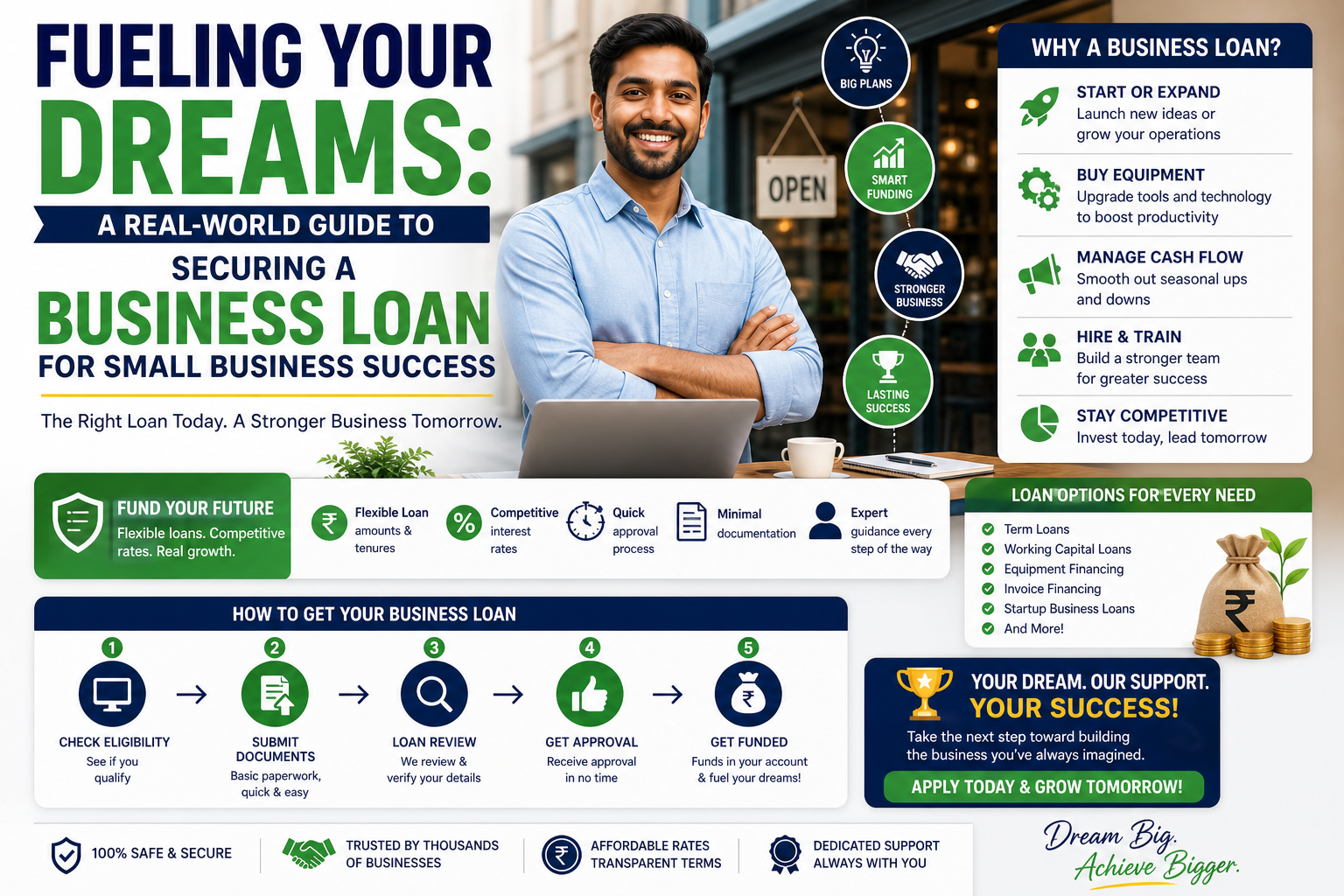
Scaling your company? Learn how to navigate the 2026 lending landscape and secure a business loan for small business growth with our expert, human-led guide.
If you’ve ever sat at your kitchen table at 2:00 AM, staring at a spreadsheet and wondering how you’re going to fund that next big shipment or hire the lead developer you desperately need, you aren’t alone. Every founder reaches a point where “bootstrapping” stops being a badge of honor and starts being a bottleneck. The leap from a passion project to a scalable enterprise almost always requires an infusion of capital. But let’s be honest: walking into a bank or scrolling through digital lenders to find a business loan for small business needs can feel like walking into a high-stakes poker game where you don’t quite know the rules.
The truth is, the lending environment in 2026 has shifted. While there is plenty of capital available, lenders have become far more surgical about where they put it. They aren’t just looking at your credit score anymore; they’re looking at your “business health” in real-time. Finding the right business loan for small business growth isn’t just about getting a “yes”—it’s about finding terms that don’t strangle your cash flow six months down the line. It’s about strategy, preparation, and a little bit of old-school storytelling.
Understanding the 2026 Lending Landscape
We’ve moved past the era of generic bank appointments. Today, when you seek a business loan for small business expansion, you’re looking at a diverse ecosystem of traditional banks, fintech disruptors, and community lenders. Each has a different “appetite” for risk. Traditional banks are still the go-to for the lowest interest rates, but they are notorious for their mountain of paperwork and slow approval times.
On the other hand, online alternative lenders have streamlined the process. They can often approve a business loan for small business operations in as little as 24 hours by plugging directly into your accounting software. However, you pay for that speed in the form of higher APRs. As a business owner, your job is to weigh that “cost of capital” against the potential ROI of the project you’re funding. If that loan helps you land a contract that triples your revenue, a slightly higher interest rate is just the cost of doing business.
Types of Funding: Which One Fits Your Season?
Not every business loan for small business use is a simple lump sum of cash. In fact, choosing the wrong “flavor” of debt is one of the most common mistakes I see. You need to match the type of capital to the specific problem you’re trying to solve.
- Term Loans: The classic. You get a set amount of cash and pay it back over a fixed period. This is best for long-term investments like equipment or office space.
- Lines of Credit: Think of this as a safety net. You only pay interest on what you use. This is the gold standard for managing seasonal cash flow dips.
- SBA Loans: These are government-backed loans that offer incredible rates. If you can handle the longer wait times, an SBA 7(a) is often the business loan for small business owners’ best friend.
- Invoice Factoring: If you have slow-paying corporate clients, you can essentially “sell” your unpaid invoices to get cash today.
The Preparation: Making Your Case Irresistible
Lenders are inherently cynical. They wake up every day looking for reasons to say “no.” To get your business loan for small business approval, you have to make it nearly impossible for them to reject you. This starts with your documentation.
I always tell founders to treat their loan application like a first date—you want to show your best self, but you have to be honest. Have your last two years of tax returns, your year-to-date profit and loss statement, and a clean balance sheet ready to go. But more importantly, have a “Use of Funds” statement. If you tell a lender you need a business loan for small business growth to “buy $50,000 worth of inventory to fulfill a confirmed purchase order from Target,” you’re a much safer bet than someone who just needs “working capital.”
Why Your “Business Credit” Matters More Than Ever
Many entrepreneurs make the mistake of relying solely on their personal credit. While a lender will almost certainly look at your personal FICO score, they are increasingly focused on your business credit profile. Agencies like Dun & Bradstreet or Experian Business track how you pay your vendors.
If you want to secure a business loan for small business needs at a competitive rate, you need to prove your company is a standalone entity that pays its bills. If you’ve been paying your suppliers late, fix that now. A strong business credit score can be the difference between a 7% interest rate and a 12% interest rate. For a deep dive into how these scores are calculated, the Small Business Administration (SBA) provides excellent guides on credit building.
The Role of Cash Flow in Approval
Revenue is vanity, but cash flow is sanity. A lender doesn’t care if you did $1 million in sales last year if your bank account is empty at the end of every month. When they review your application for a business loan for small business funding, they are looking for “Debt Service Coverage Ratio” (DSCR).
Basically, they want to see that after you pay all your expenses and your own salary, there is enough left over to comfortably cover the new loan payment. If things are tight, consider cutting unnecessary overhead for three months before you apply. Showing a trend of increasing net income makes you a prime candidate for a business loan for small business support.
Navigating the Digital Lending Maze
If you decide to go the fintech route for your business loan for small business needs, be prepared for a different kind of scrutiny. These lenders use algorithms to scan your bank transactions. They look for “nsf” (non-sufficient funds) alerts or wild swings in your daily balance.
The benefit here is speed. I’ve seen companies get a business loan for small business payroll needs in 12 hours. The downside is that these loans often require daily or weekly withdrawals from your bank account. This can be a shock to your system if you aren’t prepared for it. Always read the fine print regarding “origination fees” and “prepayment penalties.” You don’t want to find out too late that you’re being charged a 5% fee just to get the money into your account.
Community Banks: The Overlooked Secret
In an age of global fintech, the local community bank is still a powerhouse for the right kind of founder. These banks often have specific mandates to provide a business loan for small business owners in their own backyard.
Unlike the big national banks, a local branch manager has the autonomy to look at the “human” behind the numbers. If you have a long-standing relationship with a local bank, they might give you a business loan for small business expansion based on your reputation in the community, even if your collateral is a bit thin. Never underestimate the power of a face-to-face meeting. For more on the history of community lending, Wikipedia’s entry on Community Development Financial Institutions is a great resource.
Red Flags to Avoid When Borrowing
When you’re desperate for capital, you can become a target for predatory lenders. If a lender promises a “guaranteed” business loan for small business regardless of your history, or if they ask for “upfront fees” before the loan is funded, run the other way.
Another red flag is the “stacking” of loans. This is when you take out one high-interest loan to pay off another. It is the fastest way to sink a healthy company. A business loan for small business should be a ladder to the next level, not a hole you’re digging for yourself. If the numbers don’t work, it is often better to pivot your business model or seek an equity partner than to take on “bad debt.”
The Impact of Interest Rates in 2026
We are currently in a “higher for longer” interest rate environment. This means that a business loan for small business use is more expensive today than it was five years ago. This changes the math of your investment.
Before signing on the dotted line, run a sensitivity analysis. If your sales grow 10% slower than expected, can you still afford the loan? If the answer is no, you might want to scale back the loan amount. Borrowing exactly what you need—rather than the maximum the bank offers—is a hallmark of a mature CEO. A business loan for small business should always be sized to your actual requirement, not your ambition.
FAQ Section
1. How long do I need to be in business to get a loan? Most traditional lenders want to see at least two years of profitable operations. However, some online lenders offer a business loan for small business startups with as little as six months of revenue history, provided you can show a strong daily cash flow.
2. What is a “personal guarantee” and do I need one? Almost every business loan for small business will require a personal guarantee. This means if the business fails, you are personally responsible for paying the debt. It’s a high-stakes commitment, so make sure you’re confident in your business’s ability to repay.
3. Can I get a business loan for small business with bad credit? Yes, but it will be expensive. You may have to look at “merchant cash advances” or “equipment financing” where the equipment itself acts as collateral. While it’s possible to get a business loan for small business with poor credit, your first goal should be using that capital to rebuild your credit for future, cheaper borrowing.
4. What is the difference between a loan and a line of credit? A term loan is a one-time lump sum. A line of credit is a revolving facility. For most entrepreneurs, a line of credit is the more flexible business loan for small business option because you only pay for what you actually use.
5. How much can I actually borrow? Generally, lenders will offer a business loan for small business in the range of 10% to 30% of your annual gross revenue. This depends heavily on your industry and your existing debt levels.
6. Does applying for a loan hurt my credit score? A formal application usually involves a “hard pull” on your credit, which can cause a small, temporary dip in your score. However, many modern lenders offer “pre-qualification” for a business loan for small business which uses a “soft pull” that doesn’t impact your score at all.
Conclusion
At the end of the day, your business is your baby. Taking on debt is a significant step that requires both courage and a cool head. Securing a business loan for small business growth isn’t just a financial transaction; it’s an investment in your own vision.
