
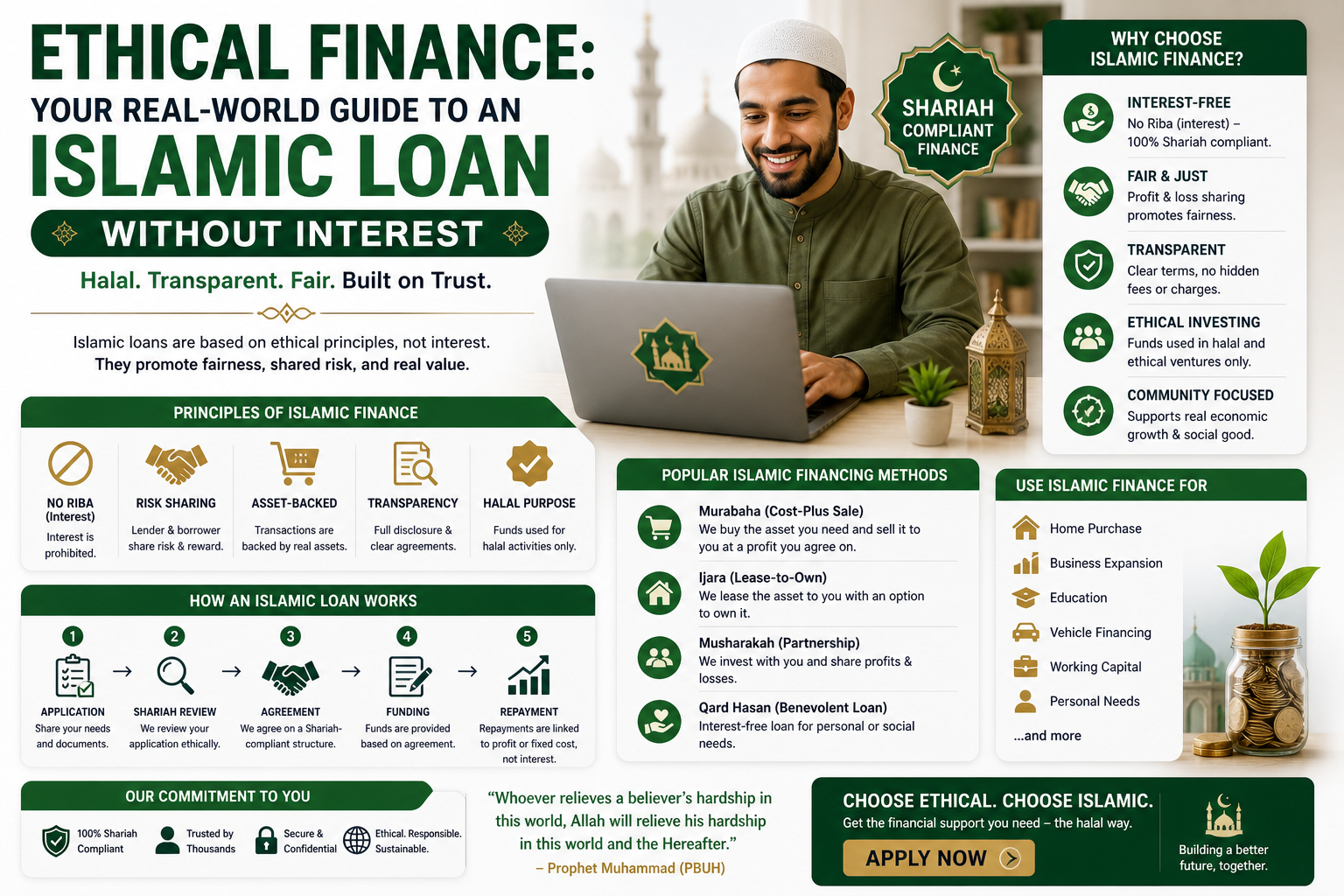
Navigating Sharia-compliant finance? Discover how to secure an Islamic loan without interest, understand Murabaha vs. Ijara, and find ethical lending in 2026.
Table of Contents
If you’ve ever looked at a standard bank contract and felt a bit uneasy about the mountain of compound interest waiting for you, you aren’t alone. For many of us, especially within the Muslim community, the traditional lending model doesn’t just feel like a financial burden—it feels like a compromise of values. We live in a world where debt is often treated as a commodity to be traded, but there is a growing movement toward a more equitable way of handling money. Whether you’re looking to buy your first home, start a business, or cover an emergency, finding a legitimate Islamic loan without interest is about more than just avoiding a percentage sign; it’s about participating in a system built on shared risk and ethical transparency.
I’ve talked to many people who think that “interest-free” is just a marketing gimmick or that the fees end up being the same as a conventional loan. While it’s true that banks aren’t charities, the mechanics of a Sharia-compliant facility are fundamentally different. When you opt for an islamic loan without interest, you are entering into a partnership or a trade agreement rather than a simple debtor-creditor relationship. In 2026, the global Islamic finance market has matured significantly, making these options more accessible to everyone, regardless of their faith, who prefers a more socially responsible way to borrow.
The Core Philosophy: Why No Interest?
In conventional banking, money is treated as something that can generate more money just by sitting there or being lent out. In Islamic finance, money is simply a medium of exchange. It has no intrinsic value. Therefore, charging someone for the “use” of money (Riba) is seen as exploitative. When you seek an islamic loan without interest, you are looking for a structure where the lender makes a profit through trade, investment, or service fees, rather than by penalizing you for the time it takes to pay back a principal amount.
This philosophy promotes a much healthier economic cycle. Lenders can’t just throw money at anyone and hope for the best; they have to be invested in the success of the project or the value of the asset. This “Asset-Backed” nature is the hallmark of a genuine islamic loan without interest. If the bank is buying a car for you to pay back over time, they own that car during the process, sharing in the physical reality of the transaction. It’s a grounded approach to finance that stood remarkably resilient during the global banking fluctuations of the last decade.
Common Structures of Interest-Free Financing
Since a bank still needs to cover its lights and pay its staff, how does an islamic loan without interest actually work in practice? It usually boils down to three main structures that you’ll encounter when talking to a Sharia-compliant advisor.
- Murabaha (Cost-Plus Profit): This is common for car or home purchases. The bank buys the item for $X and sells it to you for $X + a transparent profit margin. You pay this back in installments. It’s fixed, clear, and there are no hidden surprises.
- Ijara (Lease-to-Own): Think of this as a long-term rental where your payments go toward eventually owning the asset. It’s a popular way to structure an islamic loan without interest for property.
- Qard al-Hasan (The Benevolent Loan): This is the purest form of an islamic loan without interest. It is often used for emergencies or small community boosts where the borrower only pays back the exact amount borrowed. While rare in commercial banks, it is becoming a staple in “Fintech” micro-lending circles.
Navigating the 2026 Market for Ethical Loans
The landscape has changed. You no longer have to live next to a specialized branch in London or Dubai to access these tools. The rise of digital banking has brought the islamic loan without interest to your smartphone. Platforms are now using blockchain and real-time verification to ensure that every transaction is “Halal” and transparent from start to finish.
However, you still need to be a savvy consumer. Just because a website has a green logo doesn’t mean it’s the right fit for you. When comparing an islamic loan without interest, look at the “Total Cost of Finance.” Since there is no interest rate to compare, look at the profit margin and the admin fees. In many cases, the transparency of an islamic loan without interest makes it easier to budget because your monthly payment won’t fluctuate with central bank rate hikes. You can learn more about these global standards on the Accounting and Auditing Organization for Islamic Financial Institutions (AAOIFI) website.
Why “Risk-Sharing” Protects the Borrower
One of the most human elements of an islamic loan without interest is the concept of risk-sharing. In a conventional loan, if you buy a house and the market crashes, the bank still wants their full interest. In some Sharia-compliant models, like Musharaka, the bank is essentially a co-owner. While this is more common in business financing, the spirit of the islamic loan without interest is that the lender shouldn’t profit from the borrower’s hardship.
This creates a level of “Mutual Protection.” Because the bank is tied to the asset, they are incentivized to ensure you aren’t over-leveraging yourself. They do more due diligence on the value of what you’re buying. For many, this makes an islamic loan without interest a safer entry point into big financial commitments. It feels less like being hunted by a collector and more like working with a silent partner. For a deeper dive into the history of these models, Wikipedia’s entry on Islamic Banking is a great resource.
Eligibility and the “Paperwork” Myth
There is a lingering myth that getting an islamic loan without interest requires a mountain of extra paperwork. In reality, the requirements are very similar to conventional loans. You’ll need proof of steady income, a decent credit history, and residency documents. The difference lies in the contract.
When you apply for an islamic loan without interest, the lender will spend more time explaining the “Sale Agreement” or the “Lease Terms.” They have a religious and ethical obligation to ensure you understand exactly where every cent is going. This transparency is a breath of fresh air in an industry often clouded by fine print. If you’re a salaried professional with a stable job, you’ll find that qualifying for an islamic loan without interest is just as fast as any digital personal loan in 2026.
The Rise of Community-Based Lending
Beyond the big banks, we’re seeing a beautiful resurgence of “Credit Unions” and “Investment Clubs” that offer an islamic loan without interest through a pool of community funds. This is the digital version of the old Committee or Chit Fund systems. Members contribute monthly, and when someone needs a lump sum for a wedding or a medical bill, they take an islamic loan without interest from the pool.
This model is inherently social. It relies on trust and community backing rather than just a cold credit score. For many entrepreneurs in 2026, these community-driven islamic loan without interest options are the only way to get a project off the ground without selling their soul to venture capitalists. It’s finance with a face, and it’s remarkably effective at building local wealth.
Comparing the Costs: Is It Actually Cheaper?
This is the question everyone asks: “Will I save money?” My mild opinion is that you shouldn’t choose an islamic loan without interest solely to save a few dollars—you should choose it for the peace of mind. Sometimes, the profit margin on an islamic loan without interest might be slightly higher than a conventional “teaser” interest rate because the bank is taking on more of the legal and physical risk.
However, when you factor in the lack of “late payment interest” (which is forbidden) and the absence of complex compounding, the total cost of an islamic loan without interest often works out to be very competitive over the long term. More importantly, there is no “Interest on Interest.” If you hit a rough patch, the bank might charge a flat late fee (often donated to charity), but your debt won’t spiral out of control like a snowball in a blizzard.
Digital Security and Sharia Compliance
As we move deeper into the digital age, the security of your islamic loan without interest is paramount. Legitimate lenders use high-level encryption and are regulated by national financial authorities. In 2026, most Sharia-compliant apps also have a “Sharia Board” certificate visible in the app. This is your guarantee that a group of scholars and financial experts has audited the “Backend” of the islamic loan without interest to ensure it stays true to ethical principles. Never share your private keys or passwords with anyone claiming to facilitate a “Guaranteed” islamic loan without interest on social media; stick to regulated platforms.
FAQ Section
1. Is an Islamic loan without interest only for Muslims? Not at all! Anyone can apply for an islamic loan without interest. Many people choose these products because they prefer the ethical transparency, the fixed-cost structure, and the lack of predatory compounding interest that is common in conventional banking.
2. How does the bank make money if there is no interest? The bank makes money through “Trade” or “Leasing.” For example, in a Murabaha agreement for an islamic loan without interest, the bank buys the asset and sells it to you at a transparent profit. It’s a service fee for the convenience of paying over time, not a charge on the money itself.
3. What happens if I miss a payment? In an islamic loan without interest, the bank cannot charge “Compounding Interest” on late payments. They may charge a small, flat penalty fee to encourage discipline, but in many Sharia-compliant models, this fee is donated to charity rather than kept as profit by the bank.
4. Can I use an Islamic loan without interest to start a business? Yes, this is one of the best uses for these tools. Models like Mudaraba or Musharaka are designed specifically for business. Instead of a standard islamic loan without interest, the bank becomes a partner in your business, sharing in both the profits and the risks.
5. Is the “Profit Rate” the same as an interest rate? Mathematically, they might look similar, but legally and ethically, they are different. An interest rate is a price on time and money. A profit rate in an islamic loan without interest is a price on a specific asset or service. It’s the difference between “Lending” and “Trading.”
6. Are there Islamic loans without interest for students? Yes, several specialized organizations and educational trusts offer a Qard al-Hasan style islamic loan without interest for students. These are often funded by community endowments (Waqf) and allow students to pay back only what they borrowed once they find employment.
Conclusion
At the end of the day, money should be a tool that helps you build a better life, not a chain that keeps you awake at night. Choosing an islamic loan without interest is a powerful way to align your financial needs with your ethical values. It’s about choosing transparency over complexity and partnership over exploitation.
