
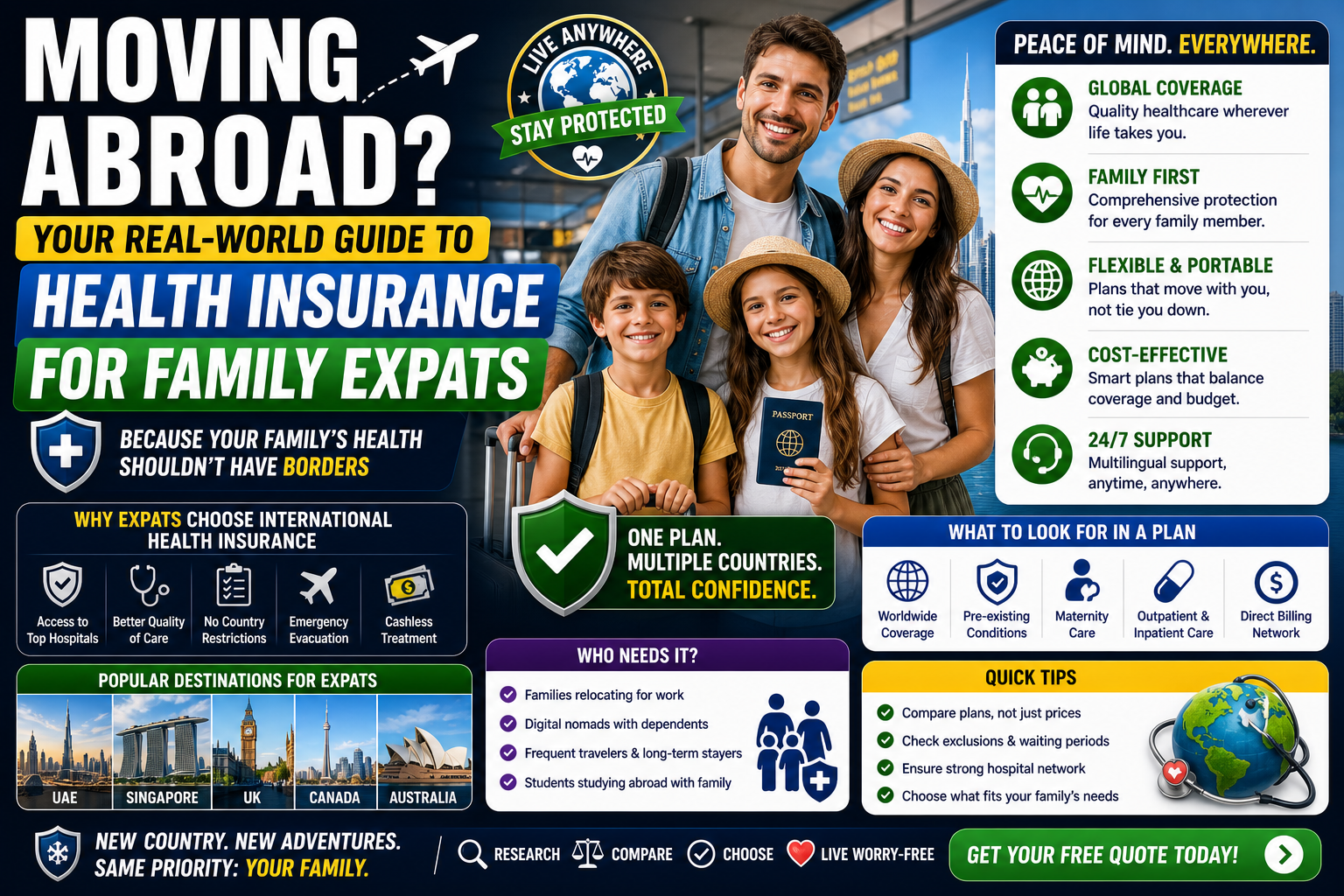
Navigating medical care in a new country is tough. Discover how to find the best health insurance for family expats, compare global plans, and protect your kids.
Table of Contents
Moving your entire life across an ocean or a border is an exhilarating, exhausting, and slightly terrifying adventure. You’ve probably spent months obsessing over visa paperwork, international schools, and which neighborhood has the best coffee. But then, reality hits in the form of a 2:00 AM fever or a playground scrape, and you realize you have no idea how the local medical system works. This is usually the moment when the importance of health insurance for family expats moves from a “boring admin task” to an absolute priority.
I’ve lived the expat life, and I know the sinking feeling of standing in a pharmacy where you can’t read the labels or trying to find a pediatrician who speaks your language. The global healthcare landscape is a confusing patchwork. What works in London won’t work in Dubai, and the system in Singapore is a far cry from the one in Spain. Finding a comprehensive policy for health insurance for family expats isn’t just about paying bills; it’s about ensuring that your kids have access to the same level of care they had back home—if not better.
Why Your “Home” Policy Doesn’t Make the Trip
One of the most common mistakes I see is families assuming their domestic private insurance will somehow stretch to cover them abroad. Most local policies are strictly tied to your residency and tax status. Once you leave, that safety net often vanishes. Even if your current provider offers “travel” coverage, it’s usually designed for short-term emergencies, not for the routine check-ups, vaccinations, and chronic care that a growing family needs.
For a life lived in transition, you need an International Private Medical Insurance (IPMI) plan. This is the gold standard of health insurance for family expats because it offers global portability. If your career takes you from the humidity of Bangkok to the mountains of Switzerland, your coverage follows you. You aren’t just buying insurance; you’re buying a portable medical identity that ensures you never have to “start over” with a new provider every time you cross a border.
Decoding the Layers of Expat Coverage
When you start shopping for health insurance for family expats, you’ll realize very quickly that “cheap” can be very expensive in the long run. International plans are modular, which is great for customization but confusing for the uninitiated. To protect your tribe, you need to look at four specific pillars of coverage.
1. Inpatient and Emergency Care
This is the “big stuff.” Surgeries, hospital stays, and emergency room visits. This is the core of any health insurance for family expats policy. It ensures that if a major medical event happens, you aren’t hit with a six-figure bill that wipes out your relocation savings.
2. Outpatient and GP Visits
For families, this is where you’ll actually use the plan most. It covers the visits to the family doctor, specialists, and diagnostic tests like X-rays or blood work. Some plans for health insurance for family expats allow you to opt-out of outpatient care to lower the premium, but for those with young children, I wouldn’t recommend it. The cost of routine visits in expat-heavy hubs like Hong Kong or Singapore adds up incredibly fast.
3. Medical Evacuation and Repatriation
This is a non-negotiable feature. If you’re living in a region where specialized pediatric surgery isn’t available, medical evacuation coverage ensures your child is flown to the nearest center of excellence. Without this in your health insurance for family expats plan, you could be looking at a $50,000 private flight out of your own pocket.
4. Maternity and Newborn Care
If you’re planning to grow your family abroad, you need to look at this early. Most health insurance for family expats plans have a 10-to-24-month waiting period before they cover pregnancy. You can’t buy the policy while pregnant and expect the delivery to be covered.
Navigating the 2026 Global Healthcare Market
In the current year, the market for health insurance for family expats has become much more tech-centric. We are seeing a massive shift toward “Telehealth-first” models. Most top-tier providers now offer 24/7 video access to English-speaking doctors. As a parent, being able to talk to a doctor at 3:00 AM from your smartphone is a game-changer. It saves you the stress of a late-night trip to a foreign ER for a simple ear infection.
However, don’t let the shiny apps distract you from the “Provider Network.” The best health insurance for family expats is the one that has direct billing agreements with the top international hospitals in your new city. You don’t want to be paying $2,000 upfront and waiting six weeks for a reimbursement. You want to present your card, pay your small co-pay, and walk out. For a deeper understanding of how these global networks are regulated, Wikipedia’s entry on International Healthcare provides a solid foundation on the different national models you might encounter.
Balancing the Premium vs. The Deductible
I’ll be honest: health insurance for family expats is an investment. It’s not uncommon for a family of four to pay $5,000 to $10,000 a year for a high-end global plan. But you have levers to control the cost.
One of the most effective ways to lower your premium is by increasing your “Deductible” (the amount you pay before the insurance kicks in). If you have a healthy family and an emergency fund, taking a $1,000 deductible can slash your monthly costs significantly. However, if your kids are in daycare and catch every bug that goes around, a $0 deductible health insurance for family expats plan might actually save you more money over twelve months. It’s about being honest with your family’s medical “usage.”
Pre-existing Conditions: The Expat’s Hurdle
This is where things get tricky. If you or your children have a pre-existing condition—like asthma, diabetes, or even a past surgery—you need to be very strategic. Standard health insurance for family expats often excludes these.
You generally have two options for underwriting:
- Full Medical Underwriting: You disclose everything, and the insurer tells you exactly what they will and won’t cover. This is my preferred method for health insurance for family expats because it provides “certainty.”
- Moratorium: No health questions are asked, but any condition you’ve had in the last five years is automatically excluded for the first two years of the plan.
If your employer is providing your health insurance for family expats, ask if it’s a “Medical History Disregarded” (MHD) plan. This is the holy grail for expats because it covers pre-existing conditions from day one. According to World Health Organization standards, access to continuous care is a fundamental health right, and MHD plans are the best way to secure that during a move.
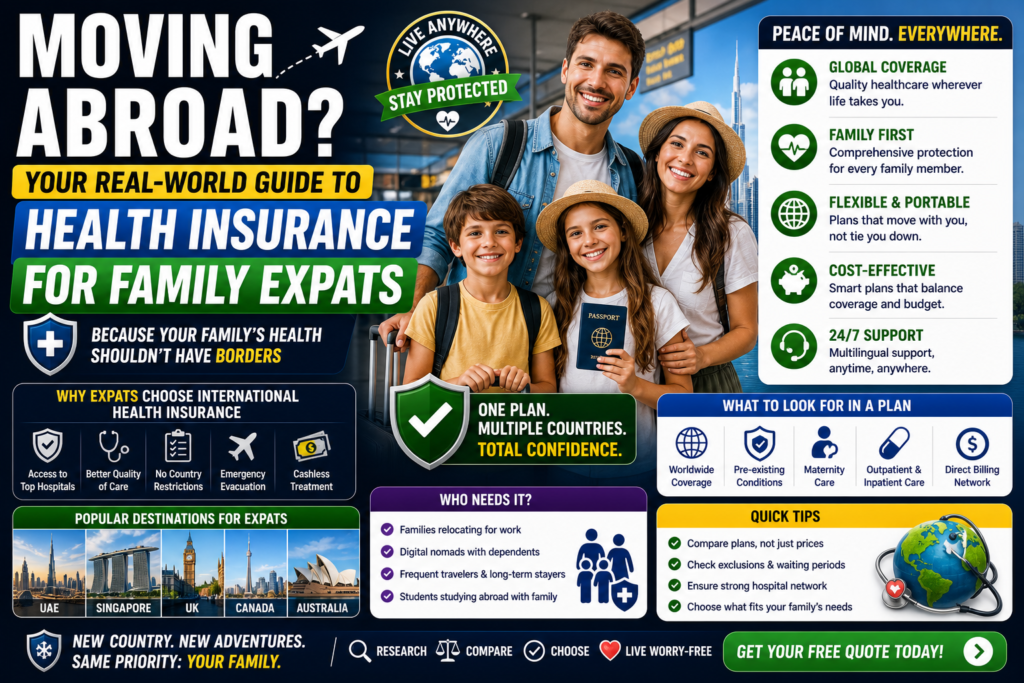
Top Providers to Watch in 2026
The landscape for health insurance for family expats is dominated by a few heavy hitters who have spent decades perfecting global claims processing.
- Cigna Global: Known for their modular plans. You can basically build a custom policy for your family.
- Bupa Global: Often seen as the premium choice with the widest network of luxury clinics.
- Allianz Care: Exceptional for families who want a very user-friendly digital experience and fast claims.
While these are the big names, always check if there’s a local “hybrid” plan. In some countries, a local insurer might partner with a global one to offer a tailored health insurance for family expats package that gives you better access to specific local specialists while still offering global emergency cover.
Red Flags to Avoid When Shopping
When you’re deep in the search for health insurance for family expats, don’t get seduced by “travel insurance” prices. Travel insurance is for vacations; it is not meant for people living abroad. If a provider sees you’ve been in a country for six months on a travel policy, they can legally deny your claims.
Another red flag is a lack of “Life-time Renewability.” You want a health insurance for family expats policy that the insurer cannot cancel just because you get sick. If someone in your family develops a chronic illness, you need to know that your insurer will continue to cover you year after year. Without this guarantee, you could find yourself “uninsurable” in the future.
FAQ Section
1. Is health insurance for family expats mandatory for visas? In many popular expat destinations like the UAE, Germany, and Thailand, having a specific level of health insurance for family expats is a legal requirement for your residency permit. Always check the “minimum requirements” for your specific visa type before buying a plan.
2. Does expat insurance cover my home country? Most global policies for health insurance for family expats include “Home Country Cover” for a limited time (usually 90 days per year). This is vital for those who want to see their regular doctors while back home for the holidays.
3. Can I keep my health insurance for family expats if I move to a third country? Yes! That is the primary benefit of IPMI. You simply notify your insurer of your new address. Your premium might adjust based on the local cost of care, but your health insurance for family expats remains continuous.
4. How do I know if my doctor is in the network? Every major provider of health insurance for family expats has a digital “Provider Search” tool. I always recommend looking up the top two private hospitals in your destination city before committing to a plan to ensure they have a direct-billing agreement.
5. Does it cover dental and vision? Usually, these are “add-ons.” For children, I highly recommend adding dental to your health insurance for family expats package, as orthodontic costs can be staggering in international clinics.
6. What is the “Free Look” period? Most reputable providers of health insurance for family expats offer a 14-to-30-day “Free Look” period. This allows you to read the full policy document and cancel for a full refund if the terms aren’t what you expected.
Conclusion
At the end of the day, your family is your most precious cargo. Moving them across the world is a brave move, but it shouldn’t be a reckless one. Finding the right health insurance for family expats is the “boring” work that allows the fun parts of expat life—the weekend trips, the new friends, and the cultural discoveries—to happen without the shadow of a medical crisis looming over you.
