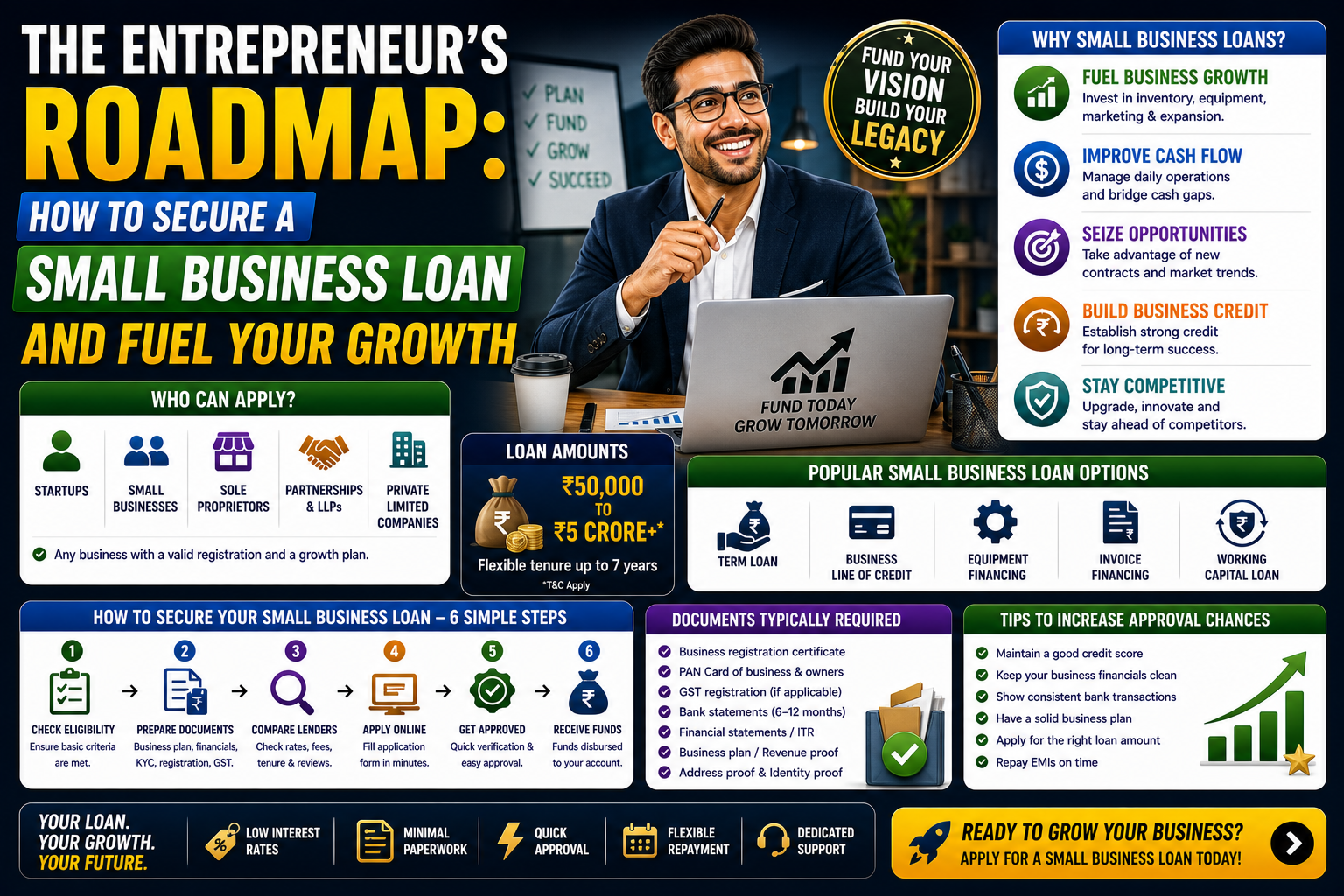
Navigating the world of business finance? Learn how to find the right small business loan for your needs, master the application process, and scale your dream.
Table of Contents
Every entrepreneur knows that exhilarating, slightly terrifying moment when your business outgrows your garage, your spare bedroom, or your current bank balance. You have the vision, the customers, and the drive, but you’re hitting a ceiling because you lack the capital to take that next big leap. Maybe you need a specialized piece of equipment, a larger storefront, or enough inventory to survive the holiday rush. Whatever the reason, the search for a small business loan is a rite of passage for almost every successful founder. It’s the moment you stop playing small and start treating your passion like the powerhouse it’s meant to be.
However, if you’ve ever looked at a bank’s lending page, you know that the process can feel like trying to read a map in a different language. There are dozens of different “products,” interest rates that fluctuate by the hour, and a list of required documents that could fill a small library. But here’s the thing: securing a small business loan isn’t about being a financial genius; it’s about preparation and matching your specific needs to the right lender. In 2026, the lending landscape is more diverse than ever, and there is a solution out there for everyone from the weekend side-hustler to the seasoned CEO.
Defining Your “Why” Before You Apply
Before you start filling out applications, you need to sit down with your books and get very clear on why you need the money. Lenders aren’t just looking at your credit score; they’re looking at your “use of proceeds.” If you tell a banker you want a small business loan for “general expenses,” you’re likely to get a lukewarm response. They want to hear that you’re buying a new delivery van that will increase your daily output by 30%, or that you’re hiring a specialist who will double your service capacity.
Having a concrete plan makes you a much lower-risk candidate. When you can show exactly how the small business loan will generate more revenue, the interest rate becomes less of an expense and more of an investment. In my experience, the most successful borrowers are the ones who can speak fluently about their ROI (Return on Investment). It’s about proving that the money isn’t just going to keep the lights on, but is actually the fuel that will propel the business forward.
Navigating the Different Types of Business Financing
One of the biggest hurdles is realizing that “loan” is a broad term. Depending on your situation, the best small business loan for you might not be a traditional lump sum from a bank. Let’s look at the three most common paths in 2026:
- Term Loans: The classic option. You get a set amount of cash upfront and pay it back over a fixed period (usually 1 to 5 years). This is the gold standard for major purchases like equipment or property.
- Business Lines of Credit: Think of this as a “standby” small business loan. You’re approved for a certain amount, but you only pay interest on what you actually spend. It’s perfect for managing seasonal cash flow gaps.
- SBA Loans: Backed by the government, these offer the best interest rates but come with the most paperwork. If you have the patience, an SBA-backed small business loan is often the most affordable way to grow.
I often suggest that new founders look into lines of credit early, even before they “need” the money. Having that safety net in place is a massive stress-relief valve when a client is late on a payment or a pipe bursts in the shop.
The 2026 Lending Landscape: Fintech vs. Traditional Banks
We’ve moved past the era where your only option was the local bank branch on Main Street. Today, the world of the small business loan is split between legacy institutions and agile fintech challengers.
Traditional banks still offer the lowest interest rates, but they are notoriously “picky.” They want to see years of tax returns and perfect credit. Fintech lenders, however, use sophisticated algorithms to look at your real-time cash flow. They might look at your Shopify sales or your QuickBooks data to approve a small business loan in forty-eight hours. The convenience comes with a slightly higher price tag, but for many fast-moving businesses, the speed is worth the extra percentage point. For a deeper look at how these financial systems are regulated, Wikipedia’s entry on Small Business Administration offers great background on the mechanics of government-backed lending.
Mastering the “Big Three” Requirements
To walk away with a “Yes,” you need to satisfy the lender’s curiosity in three main areas. If you want a small business loan, you need to have these ready:
- Credit History: Both your personal and business credit scores will be under the microscope. If you’ve been diligent with your own bills, it bodes well for your business reliability.
- Cash Flow and Revenue: Lenders want to see that your business has a pulse. They’ll look at your bank statements to ensure you have enough “leftover” cash to cover the new monthly payment.
- Collateral: For a larger small business loan, you might need to “back” the debt with an asset like equipment, real estate, or even your personal home. “Unsecured” loans exist, but they are harder to get and more expensive.
According to data from the U.S. Chamber of Commerce, being proactive with your documentation can shave weeks off the approval process. Don’t wait for them to ask; have your last two years of tax returns and your current P&L statement ready in a digital folder.
How to Handle the “New Business” Hurdle
If you’ve been in business for less than two years, getting a traditional small business loan can feel like an uphill battle. Most banks want to see a track record of stability. But don’t let that discourage you.
Startups often find their version of a small business loan through “Equipment Financing” or “Invoice Factoring.” If you’re buying a $50,000 espresso machine, the machine itself acts as the collateral, making the bank much more likely to say yes to a young business. Alternatively, if you have $20,000 in outstanding invoices from reliable clients, some lenders will give you a small business loan based on those future payments. It’s all about finding the niche that fits your current stage of growth.
The True Cost: Interest Rates vs. APR
When you’re comparing offers, it’s easy to get distracted by a “low interest rate.” But you have to look at the APR (Annual Percentage Rate). A small business loan might have a 7% interest rate but a 3% “origination fee” and a monthly “maintenance fee.”
When you add those up, your 7% loan is actually costing you 11%. Always ask the lender for the “Total Cost of Capital.” A truly transparent partner will be happy to break down every cent. If they’re being vague about the fees, it’s a major red flag. A small business loan should be a transparent partnership, not a series of unpleasant surprises.
Why a Business Plan Still Matters
In the age of digital applications, some people think the “Business Plan” is dead. I disagree. While you might not need a 50-page leather-bound book, having a concise “Pitch Deck” or a “Executive Summary” when you apply for a small business loan shows that you are a professional.
It shows that you’ve thought about your competitors, your marketing strategy, and your risks. When a loan officer sees a well-thought-out plan, they see a founder who is less likely to default. It gives them the “warm and fuzzy” feeling they need to sign off on your small business loan. It proves that you aren’t just reacting to a crisis, but are executing a strategy.
Protecting Your Personal Assets
One mild opinion I always share with founders: try to avoid a “Personal Guarantee” if you can. This is a clause that says if the business fails, the lender can come after your personal car, house, and savings.
While almost every small business loan for a new company will require one, as you grow, you should aim to transition to “non-recourse” debt. This means the small business loan is tied only to the business itself. It’s a massive milestone for any entrepreneur because it finally separates your family’s security from your company’s risks. It’s the ultimate goal of professional financial management.
FAQ Section
1. How long does it take to get a small business loan approved? It depends on the lender. A traditional bank might take 4 to 8 weeks. An online fintech lender can often approve a small business loan and deposit the funds into your account in 2 to 5 business days.
2. Can I get a small business loan with bad credit? Yes, but it will be significantly more expensive. You may need to look at “alternative” lenders or “Microloans” from community organizations. Using a smaller small business loan to build your credit is a great long-term strategy.
3. What is the average interest rate in 2026? Currently, for a prime small business loan, rates are hovering between 7% and 12%. Factors like your industry, your time in business, and the type of collateral you provide will influence your specific rate.
4. Do I need a down payment? For some types of financing, like SBA 7(a) or 504 loans, you may need a 10% to 20% down payment. However, many working capital small business loan options don’t require any cash upfront.
5. Will a small business loan help my credit score? If the lender reports to the business credit bureaus (like Dun & Bradstreet), then yes! Paying back your small business loan on time is the single best way to build a “corporate” credit identity.
6. What is “origination” and why does it cost money? The origination fee covers the bank’s cost to process, underwrite, and fund your small business loan. It’s typically a one-time fee taken out of the loan balance before you receive it.
Conclusion
Building a business is one of the hardest things you’ll ever do, but you don’t have to do it with empty pockets. A well-placed small business loan is the bridge that gets you from where you are to where you deserve to be. It’s a tool of empowerment, allowing you to hire that first employee, buy that first pallet of inventory, or open that second location.
