
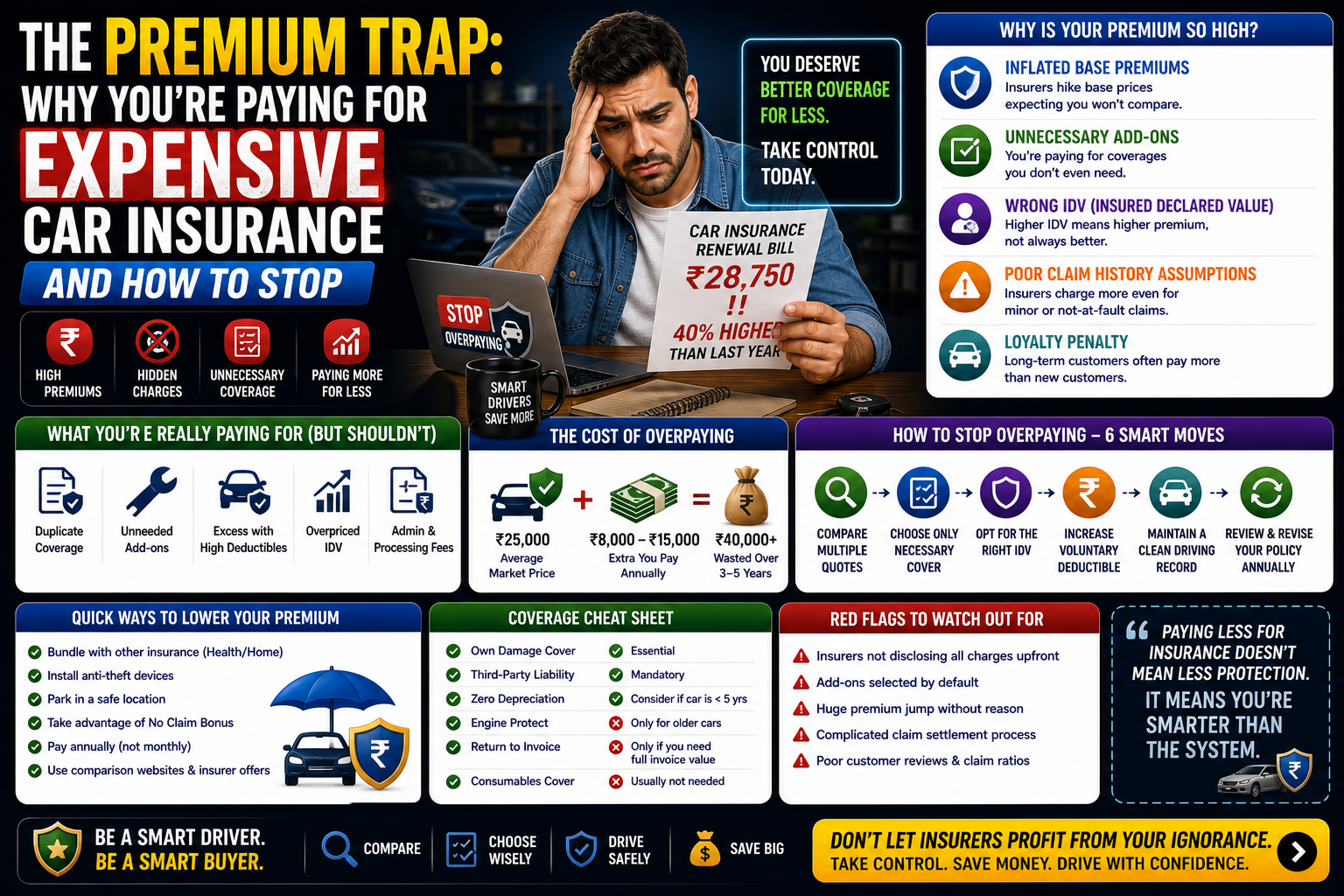
Meta Description: Tired of draining your bank account for coverage? Learn why you have expensive car insurance, how to slash your premiums, and the secrets to finding affordable rates.
Table of Contents
We’ve all had that sinking feeling in our stomach when the renewal notice hits the inbox. You open the PDF, scroll down to the total, and there it is—a number that looks more like a mortgage payment than a quote for your sedan. It’s frustrating, especially when you consider yourself a safe driver who hasn’t had a ticket since the mid-2000s. If you feel like you are being singled out by the universe to pay for expensive car insurance, you aren’t alone. In 2026, the cost of staying legal on the road has climbed to heights that feel borderline predatory for many families.
But here’s the reality: insurance companies aren’t just picking numbers out of a hat. They are using massive data sets to judge every aspect of your life, from where you sleep to how often you slam on your brakes. While it feels personal, it’s actually a very cold, mechanical calculation of risk. If you find yourself stuck with expensive car insurance, it’s usually because you’ve triggered a few specific red flags in a lender’s algorithm. The good news is that once you understand what those triggers are, you can start taking the wheel back and steering those costs down to a manageable level.
Why Does My Policy Feel So Punitive?
There isn’t just one reason for a high premium; it’s usually a “perfect storm” of factors. First, we have to look at the vehicle itself. If you’re driving a car with high-tech sensors, specialized paint, or parts that have to be shipped from overseas, you are a prime candidate for expensive car insurance. In 2026, even a minor bumper bash can cost thousands because of the calibration required for parking sensors and cameras.
Beyond the car, your geography plays a massive role. If you live in a ZIP code with high rates of theft, vandalism, or even just frequent hail storms, your insurer is going to bake that risk into your bill. This is why a move from the suburbs to a trendy downtown loft often results in a sudden, painful jump toward expensive car insurance. It’s not that you’ve become a worse driver; it’s just that your car is now “sleeping” in a higher-risk neighborhood.
The Secret Drivers of High Premiums
Most people know that accidents and speeding tickets lead to higher costs. However, there are “silent” factors that can result in expensive car insurance without you ever touching the gas pedal.
- Credit Score: In many regions, insurers use your credit history as a predictor of how likely you are to file a claim. A lower score often correlates with higher premiums.
- Coverage Gaps: If you let your insurance lapse for even a week while you were between cars, you are now seen as a “high-risk” customer, which leads directly to expensive car insurance when you re-apply.
- Marital Status and Age: Statistically, married people and those over 25 are seen as more stable, leaving single, younger drivers to foot the bill for the most expensive car insurance on the market.
It might feel unfair that your financial history impacts your driving costs, but according to the National Association of Insurance Commissioners, these correlations are mathematically significant for risk assessment.
Breaking Down the Coverage Layers
Sometimes, we have expensive car insurance simply because we are paying for things we don’t actually need. If you are driving an older vehicle that is paid off, do you really need a $0 deductible and full collision coverage? If the cost of your annual premium is more than 10% of the car’s total value, you might be over-insured.
When you sit down to audit your policy, look at the “Add-ons.” Are you paying for roadside assistance that you already get through your AAA membership or your car’s warranty? Are you paying for rental car reimbursement when you have a spare vehicle sitting in the garage? Trimming these “extras” is the fastest way to stop paying for expensive car insurance and start paying for only what matters. You can learn more about the technical definitions of these coverage types on Wikipedia’s Auto Insurance page.
The 2026 Tech Solution: Telematics
If you are convinced that the “standard” rates are unfair, it might be time to let the insurer watch you drive. Telematics, or “Usage-Based Insurance,” has become the gold standard for fighting back against expensive car insurance in 2026. By plugging a device into your car or using a smartphone app, you can prove that you don’t speed, you don’t drive at 2:00 AM, and you aren’t an aggressive braker.
For safe drivers, this can slash a premium by 30% or more. It turns the “neighborhood average” into a “personal reality.” If you are currently stuck with expensive car insurance because of your age or your ZIP code, telematics is the most effective way to “opt out” of the stereotypes and get rated on your actual performance.
Comparing the “Big Names” vs. Local Players
We are bombarded with commercials for the “Big Four” insurers every time we turn on the TV. They spend billions on marketing, and guess who pays for that? The policyholders. Often, the reason you have expensive car insurance is simply that you are paying for the brand name.
In 2026, smaller, regional insurers and digital-first startups are often able to offer much more competitive rates. They have lower overhead and are often hungrier for your business. When you go out to find an alternative to your expensive car insurance, make sure you get quotes from at least two companies you’ve never heard of. You might be surprised to find that the local provider down the street can beat the “Gecko” by hundreds of dollars a year.
The Deductible Lever: Taking the Risk
If you have a solid emergency fund, the easiest way to kill expensive car insurance is to raise your deductible. By moving from a $250 deductible to a $1,000 deductible, you are telling the insurance company that you’ll handle the small stuff yourself.
This significantly lowers the insurer’s administrative burden, and they will reward you with a much lower premium. Of course, you should only do this if you actually have that $1,000 sitting in a savings account. It’s a strategic move to lower the cost of expensive car insurance, but it requires you to be your own “mini-insurer” for minor fender benders.
Bundling and Discounts: The Low-Hanging Fruit
Are you still paying for your home and car insurance through different companies? If so, you are essentially choosing to have expensive car insurance. Bundling is the oldest trick in the book, yet thousands of people forget to do it.
Beyond bundling, ask for a “discount audit.” Do you have a student on your policy with a 3.0 GPA? That’s a discount. Did you take a defensive driving course online? That’s a discount. Do you work in a specific profession like teaching or nursing? You guessed it—discount. Many people accept expensive car insurance because they don’t realize the insurer has “hidden” savings waiting for those who ask.
When to Walk Away and Switch
Loyalty does not pay in the insurance world. In fact, many companies use a practice called “price optimization,” where they slowly raise rates on long-term customers because they know those customers are unlikely to shop around. If your rate has increased for three years in a row without you having an accident, you are being “loyalty taxed” with expensive car insurance.
I recommend shopping your rate every 12 months. In 2026, the process of switching is entirely digital and takes about fifteen minutes. There is no reason to stay in a relationship with expensive car insurance when there are dozens of other companies waiting to give you a “new customer” break.
FAQ Section
1. Why is my car insurance so expensive even though I’ve never had an accident? It could be your location, your credit score, or even the type of car you drive. Insurers also look at the “claims frequency” of people like you. If people in your neighborhood file many claims, you’ll likely end up with expensive car insurance regardless of your personal record.
2. Does the color of my car make my insurance expensive? No, that is a total myth. A red car does not lead to expensive car insurance. However, the make and model absolutely do. A luxury SUV is always more expensive to insure than a standard sedan because the repair costs are much higher.
3. Will my expensive car insurance go down when I turn 25? Generally, yes. 25 is seen as a “maturity milestone” by lenders. If you’ve maintained a clean record, you should see a significant drop in your premiums. If you don’t see a drop, it’s time to shop around and find someone who will acknowledge your “adult” status.
4. How much can I save by switching from expensive car insurance? The average driver can save between $400 and $800 a year just by comparing three different quotes. Because every company weights risk differently, one company might see you as high-risk while another sees you as a preferred customer.
5. Can a high deductible really fix expensive car insurance? Yes, it is one of the most effective levers you have. Increasing your deductible can sometimes drop your premium by 15% to 30%. Just ensure you can afford the out-of-pocket cost if an accident does occur.
6. Does my job affect how expensive my car insurance is? Yes. Some professions (like doctors or engineers) are statistically seen as more “careful,” while others might be seen as more “stressed” or “distracted.” When looking to lower expensive car insurance, always mention your job title.
Conclusion
At the end of the day, car insurance is a necessary part of modern life, but it shouldn’t feel like a monthly punishment. If you are currently feeling the weight of expensive car insurance, take it as a sign to do a little bit of financial “detective work.” Check your credit, audit your coverage, and most importantly, don’t be afraid to walk away from a company that doesn’t value your business.
