
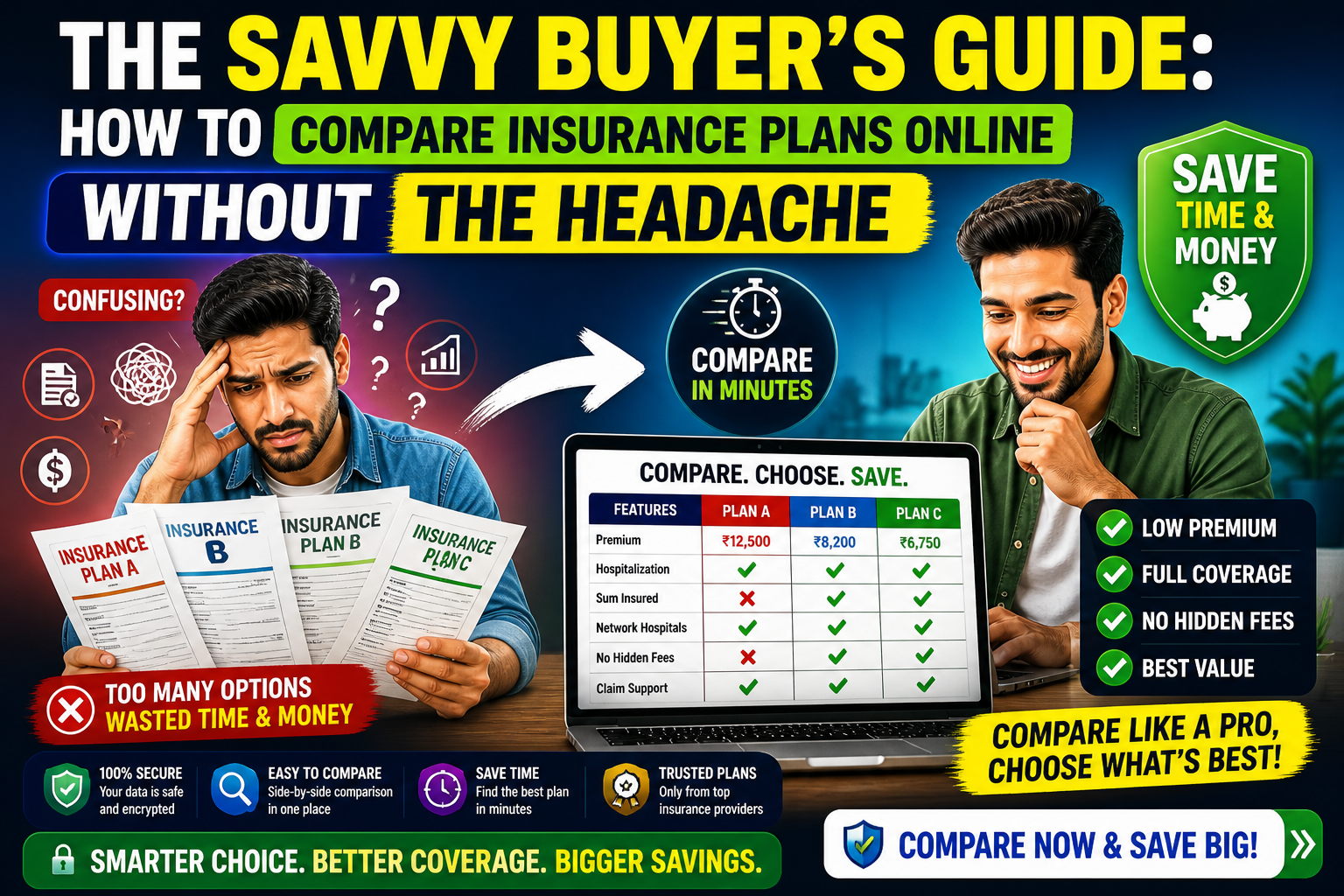
Stop overpaying for coverage. Learn how to compare insurance plans online like a pro, decode the fine print, and find the perfect balance of price and protection.
Table of Contents
We’ve all been there—staring at a renewal notice that looks more like a mortgage payment than a premium. It’s frustrating, isn’t it? You’ve been a loyal customer for years, yet the price keeps creeping up while the service stays exactly the same. In the past, your only option was to spend hours on the phone with various agents, repeating your life story over and over again. But things have changed. The power has shifted back to the consumer, and the most effective weapon in your financial arsenal is the ability to compare insurance plans online from the comfort of your own couch.
Choosing the right protection for your car, home, or health shouldn’t feel like a high-stakes game of roulette. Yet, many people avoid shopping around because the process feels overwhelming. There are too many acronyms, too much fine print, and a nagging fear that “cheaper” might actually mean “worse.” But here is the truth: the best deal isn’t always the one with the lowest price tag; it’s the one that fits your specific life situation. When you take the time to compare insurance plans online, you aren’t just looking for a bargain—you’re building a safety net that actually works when you need it most.
Why the “Loyalty Tax” is Costing You Thousands
Let’s be real for a second. Insurance companies are businesses, and they know that most people are “sticky.” They count on the fact that you’re too busy to look elsewhere. This leads to what industry insiders call the “loyalty tax”—where long-term customers end up paying significantly more than new ones for the exact same coverage.
By making it a habit to compare insurance plans online at least once a year, you essentially tell the market that your business must be earned. It’s a simple exercise that can save the average household hundreds, if not thousands, of dollars annually. Think of it as a quick financial check-up. Just as you wouldn’t keep paying for a gym membership you don’t use, you shouldn’t keep paying for a legacy insurance policy that no longer reflects the current market rates or your actual needs.
The Secret to Navigating Comparison Tools
When you start your journey to compare insurance plans online, you’ll likely land on a few big aggregator websites. These are fantastic tools, but you need to know how to use them properly. They work by pulling data from dozens of different providers and laying them out side-by-side.
However, don’t just click the very first result. To truly compare insurance plans online like an expert, you need to look at the “Three Cs”:
- Coverage Limits: Ensure you are looking at apples-to-apples comparisons. If one plan is cheaper but only covers half the liability, it’s not a better deal.
- Claims Reputation: A low premium is worthless if the company fights you for six months when you actually file a claim.
- Customer Service Ratings: Check independent reviews to see how the company treats its policyholders during a crisis.
I’ve found that the most successful shoppers are the ones who don’t rush. Take twenty minutes to really dig into those side-by-side tables. When you compare insurance plans online, the goal is to find the “Goldilocks” zone—the plan that offers robust protection without the bloated “prestige” pricing of the massive national brands.
Decoding the Jargon: What You’re Actually Paying For
One of the biggest hurdles when you sit down to compare insurance plans online is the language. Deductibles, premiums, out-of-pocket maximums—it’s enough to make anyone’s head spin.
Think of your premium as your “entry fee” to the club. Your deductible is the amount you agree to pay before the insurance company kicks in their share. If you have a healthy emergency fund, choosing a higher deductible can be a brilliant move to lower your monthly costs. This is one of the most effective levers you can pull when you compare insurance plans online. By adjusting these sliders on a comparison site, you can see in real-time how your monthly bill changes. It’s about finding a balance that lets you sleep at night without draining your bank account every month.
Why Your Personal Data Matters for Your Quote
Insurance is essentially a math game based on risk. When you compare insurance plans online, the algorithm is looking at dozens of variables: your zip code, your credit score, your age, and even your past claims history.
This is why your quote might look vastly different from your neighbor’s. If you’ve recently improved your credit score or moved to a safer neighborhood, you are statistically less of a risk. You shouldn’t wait for your current insurer to notice; you should compare insurance plans online immediately to see if you qualify for a “lower-risk” tier. According to Investopedia, this process of underwriting is how companies decide if you’re a good bet, and different companies have different “appetites” for certain types of risk.
The “Direct-to-Consumer” Advantage
In 2026, we are seeing a massive surge in digital-first insurance companies. These firms don’t have thousands of physical offices or expensive TV ad campaigns, which means they have much lower overhead. When you compare insurance plans online, you’ll often find these “challenger” brands at the top of the list for value.
While some people feel safer with the “big names,” these digital providers are often backed by the same massive reinsurers as the household names. To effectively compare insurance plans online, you should be open to these newer players. They often have better mobile apps, faster digital claims processing, and much more transparent pricing structures. It’s a classic case of modern technology making an old-fashioned industry much more efficient for the rest of us.
How Your Lifestyle Changes Your Insurance Needs
Life doesn’t stand still, and your insurance shouldn’t either. Did you get married? Start working from home? Install a new security system? All of these life events can lower your insurance risk.
If you haven’t taken the time to compare insurance plans online since your last big life change, you are almost certainly overpaying. For example, if you no longer commute 40 miles a day, your car insurance should be significantly cheaper. When you use a digital tool to compare insurance plans online, you can update these details and often see an immediate drop in your projected premiums. It’s a proactive way to ensure your money is working as hard as you are.
Avoiding the “Hidden Fee” Trap
Not all quotes are created equal. When you compare insurance plans online, be on the lookout for sneaky “admin fees” or “installment charges.” Some companies will give you a low monthly price but then charge you $5 every time you make a payment.
To get a true sense of the cost, I always suggest looking at the “Annual Total.” When you compare insurance plans online, check if the company offers a discount for paying in full. Often, you can save an additional 5% to 10% just by avoiding monthly processing fees. It’s a small detail, but in the world of personal finance, the small details are where the real savings live. You can find great benchmarking data on current industry trends through Wikipedia’s entry on Insurance.
The Importance of Multi-Policy Discounts
One of the most effective strategies when you compare insurance plans online is “bundling.” Most providers will give you a massive break if you give them both your home and auto business.
However, don’t just assume the bundle is the best deal. Sometimes, Company A has the best home rate and Company B has the best car rate—and even without the bundle discount, they are cheaper than Company C’s “all-in-one” package. The only way to know for sure is to compare insurance plans online for each policy individually and then check the bundled price. It’s a bit more legwork, but the payoff can be a nice dinner out every month for the next year.
Digital Security: Keeping Your Data Safe
I know what you’re thinking: “If I put my info into all these sites, will I get spammed for eternity?” It’s a valid concern. When you compare insurance plans online, stick to reputable, well-known comparison engines.
Check for the padlock icon in your browser and read the privacy policy. Most legitimate sites that help you compare insurance plans online are highly regulated and use bank-level encryption. They make their money from the insurance companies, not by selling your phone number to telemarketers. By using a “burner” email address for your search, you can compare insurance plans online with total peace of mind, keeping your main inbox clean while you hunt for the best rates.
FAQ Section
1. Is it actually free to compare insurance plans online? Yes! Legitimate comparison sites do not charge the consumer. They earn a commission from the insurance provider if you choose to sign up through their platform. So, you can compare insurance plans online as many times as you like without spending a dime.
2. How often should I compare insurance plans online? A good rule of thumb is to shop around once a year or whenever you have a major life event (moving, getting married, buying a new car). Even if you don’t switch, taking ten minutes to compare insurance plans online gives you the peace of mind that you’re still getting a fair deal.
3. Will comparing quotes hurt my credit score? No. When you compare insurance plans online, lenders perform what is called a “soft pull” of your credit. This does not impact your credit score at all, unlike the “hard pull” that happens when you apply for a credit card or a mortgage.
4. Can I switch plans in the middle of my current policy? In most cases, yes. You aren’t “locked in.” If you compare insurance plans online and find a significantly better deal, you can cancel your old policy. Your current insurer is usually required to refund the “unearned” portion of your premium.
5. Why are my online quotes different from my current agent’s price? Agents often have access to different “buckets” of pricing, but they also have to cover their own commissions. When you compare insurance plans online, you are often accessing “direct-to-consumer” rates that bypass the middleman, leading to lower costs.
6. What is the most important factor when I compare insurance plans online? While price is important, the “Quality of Coverage” is king. Always ensure that the liability limits and deductibles are sufficient for your actual needs. A cheap plan is a very expensive mistake if it doesn’t cover you in a total loss.
Conclusion
At the end of the day, your insurance should be a boring, reliable background player in your life. It shouldn’t be a source of stress or a drain on your future goals. The simple act of choosing to compare insurance plans online is one of the most effective ways to take control of your financial destiny.
